
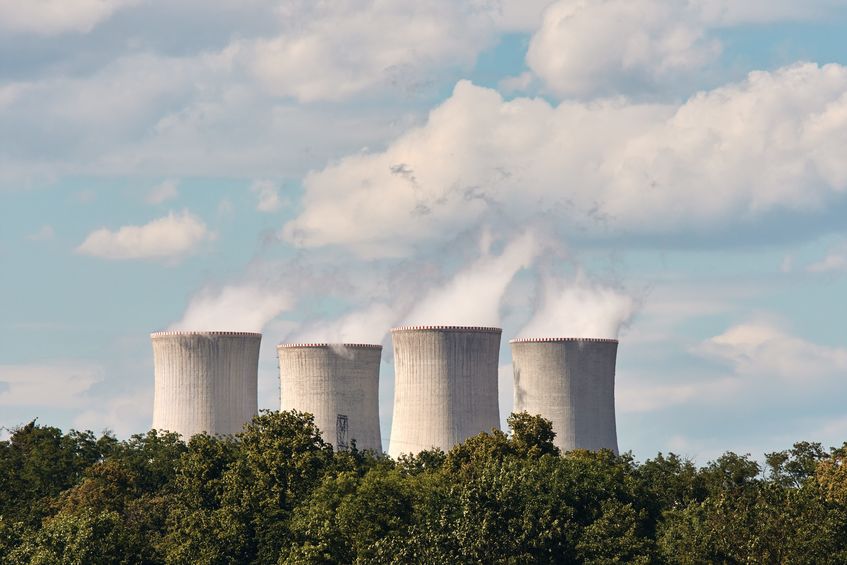
Nuclear power in Italy? Experts say it won’t happen for at least 20 years. And the issue of nuclear waste remains unresolved.

The point, setting aside the fan bases, following the approval of the Enabling Act, with the authors of the book *Avete rotto l’atomo* and Arturo Lorenzoni, professor of energy economics

It’s normal to take sides on many issues—whether it’s your favorite team, a penalty kick, a leader, or a political party. But when it comes to nuclear power, that’s not the case; the time for “cheering” is over. “We’ve had some poor-quality conversations so far, but that doesn’t mean we can’t have better ones from now on. I don’t know what the European energy system will look like in 2050, nor do I know if nuclear power will be part of Italy’s energy mix. I have my own opinions; I’ve questioned them and refined them. I couldn’t ask for more.” This reflection comes from environmental journalist Ferdinando Cotugno, who wrote the foreword to *Avete rotto l’atomo* (People Edizioni), a book for eager non-experts on nuclear energy, written by two young engineers—Matteo De Piccoli from Friuli and Giovanni Montagnani from Lombardy— with a specific intention: to break down the partisan divide between pro- and anti-nuclear camps—stirred up for decades by referendum debates—and to spark a substantive discussion that takes into account the inescapable complexity of the issue. This approach was also employed in Mestre during the initiative “Beyond the ‘Yes’ and ‘No’ to Nuclear Power,” organized by Legambiente Venezia on October 2 at the S. Maria delle Grazie Cultural Center.

The Draft Enabling Act—and then what? Is there really such a thing as “sustainable nuclear power”? Could it be part of a future energy mix combined with renewables? And how long will it take for Italy to adopt it, starting with the approval of the latest Authorizing Bill—which is currently little more than a statement of intent, passed by Parliament last September and awaiting implementing decrees in the coming months? “The nuclear industry is extremely complex. As we know, nuclear power originated because a definitive weapon was needed. In the postwar period, attempts were made to harness this incredible energy for civilian purposes. A reactor works because there is fuel inside; a neutron arrives and splits the atom; and there is a moderator—usually water—and a heat transfer fluid—also usually water—which serves to carry away the heat to be used as an energy source. In fact, we’re talking about large pressure vessels for producing hot water, inside which a nuclear chain fission reaction takes place. Essentially, there are choices to be made regarding these components, and this is where the full range of options comes into play when we talk about nuclear power.” This is explained by Matteo De Piccoli, a nuclear engineer trained at the Polytechnic University of Turin and a science communicator.

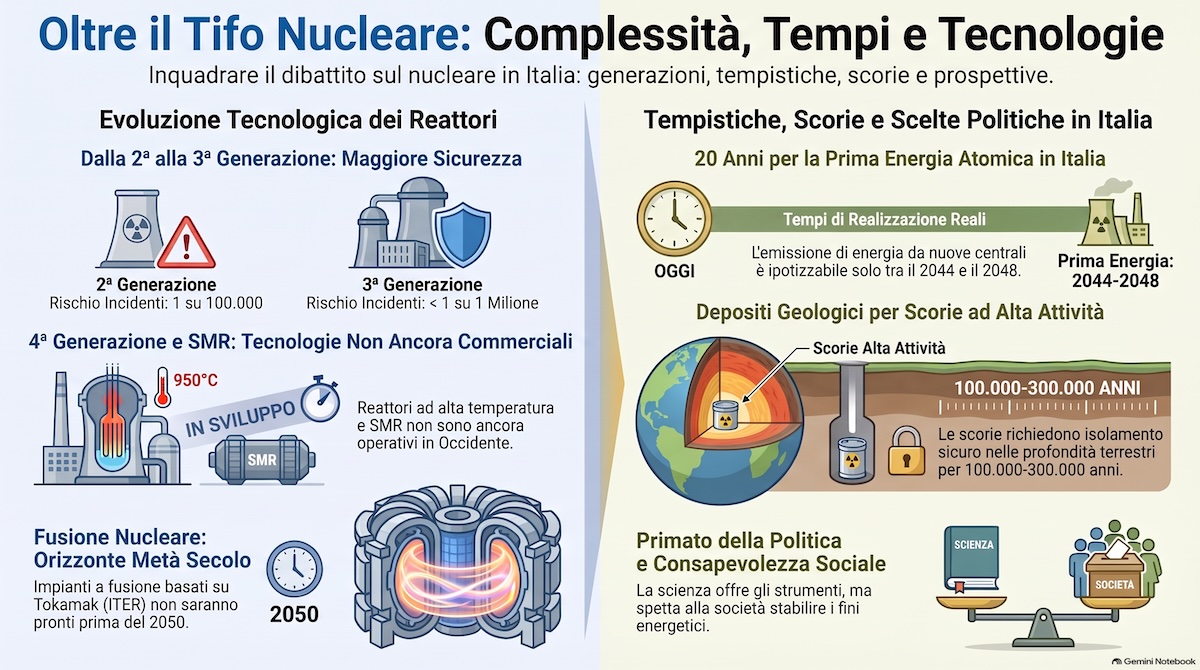
“We have first- and second-generation reactors, and today we’ve reached the third generation—and are even envisioning a fourth—and every country —Canada, France, the United States—has developed different types over time. A light-water nuclear power plant has lower efficiency than a gas-fired plant, due to constraints imposed by the type of coolant. The second generation of reactors—to put it simply—is the type found at Chernobyl and Fukushima. Third-generation reactors use similar technologies but offer greater safety: a second-generation reactor has a one-in-100,000 annual probability of causing a serious accident, while the probability for third-generation reactors is lower (less than one in a million), although it can never reach zero. When we hear about fourth-generation reactors, however, we know we’re talking about technologies that have not yet reached a commercial level—that is, they are not yet capable of being used to produce energy in an economically competitive manner. We’re moving from today’s water-cooled reactors—which operate at about 300–325 degrees Celsius with an efficiency of around 33 percent—to high-temperature reactors that reach 950 degrees, though these technologies have not yet reached a sufficient level of development.” And then there are fast reactors: it is said that their fuel can be recycled and that they will be able to utilize almost all of it—a prospect that, for now in the West, has more to do with theory than with cold, hard reality.

It Will Take 20 Years to Get Nuclear Power in Italy

Arturo Lorenzoni, a professor of Energy Economics at the University of Padua, estimates that it will take roughly twenty years from the passage of the current enabling act to the first generation of electricity from a hypothetical new power plant: “Taking the most efficient models of plants already in operation as an example, in the best-case scenario, if we started building new power plants today, we would begin to see the first energy supplied to the market between 2044 and 2048.”

The issue of nuclear waste? “We also need to agree on the meaning of the word ‘sustainable,’ De Piccoli continues. The Italian bill appears to align with the European Union’s definition of sustainable nuclear power, which refers to third-generation reactors designed to store the waste they produce—that is, spent fuel—in geological repositories. We’re talking about holes dug deep into the earth containing materials that remain hazardous for a period ranging from 100,000 to 300,000 years.” A prospect that, even in this case, is in fact still just a theory: “No country currently has a functioning geological repository for civilian waste,” De Piccoli points out. “In Finland, the first one is about to open, designed for the disposal of high-level waste—the kind that requires isolation for hundreds of thousands of years. Other countries have surface repositories for lower-activity waste, and these are what are referred to when people in Italy talk about a national repository.”

And while this may seem like a potential future, the so-called modular mini-reactors—a type of low-impact nuclear reactor not yet in operation in the West—are projected even further into the future.

Then there is the issue of fusion. Experts agree that it will take at least until the middle of the century before fusion power plants are operational—the most promising technology being the tokamak, which forms the basis of the international ITER project. With one caveat, according to authors De Piccoli and Montagnani: “For 50 years now, people have been saying that ‘nuclear fusion will arrive in 25 years.’”

Whether, how, and in which facilities—if any—to invest: that is the crux of the matter. Between what is plausible, what is real, and what is appropriate, choosing nuclear power is not just a technical issue but also a social one. “The challenge today lies in restoring a clear hierarchy of sovereignty and integrity,” write De Piccoli and Montagnani. Asserting the primacy of politics means recognizing that it is up to society to establish the goals of our coexistence, while science must return to being an honest tool in the service of those higher social objectives.” With the numbers and plans in hand, and leaving the stands and fan bases aside.

Maria Paola Scaramuzza
Author:

Iscriviti a GREEN&SALUS e non perderti nessun aggiornamento, ti invieremo 1 volta a settimana i nuovi articoli!