

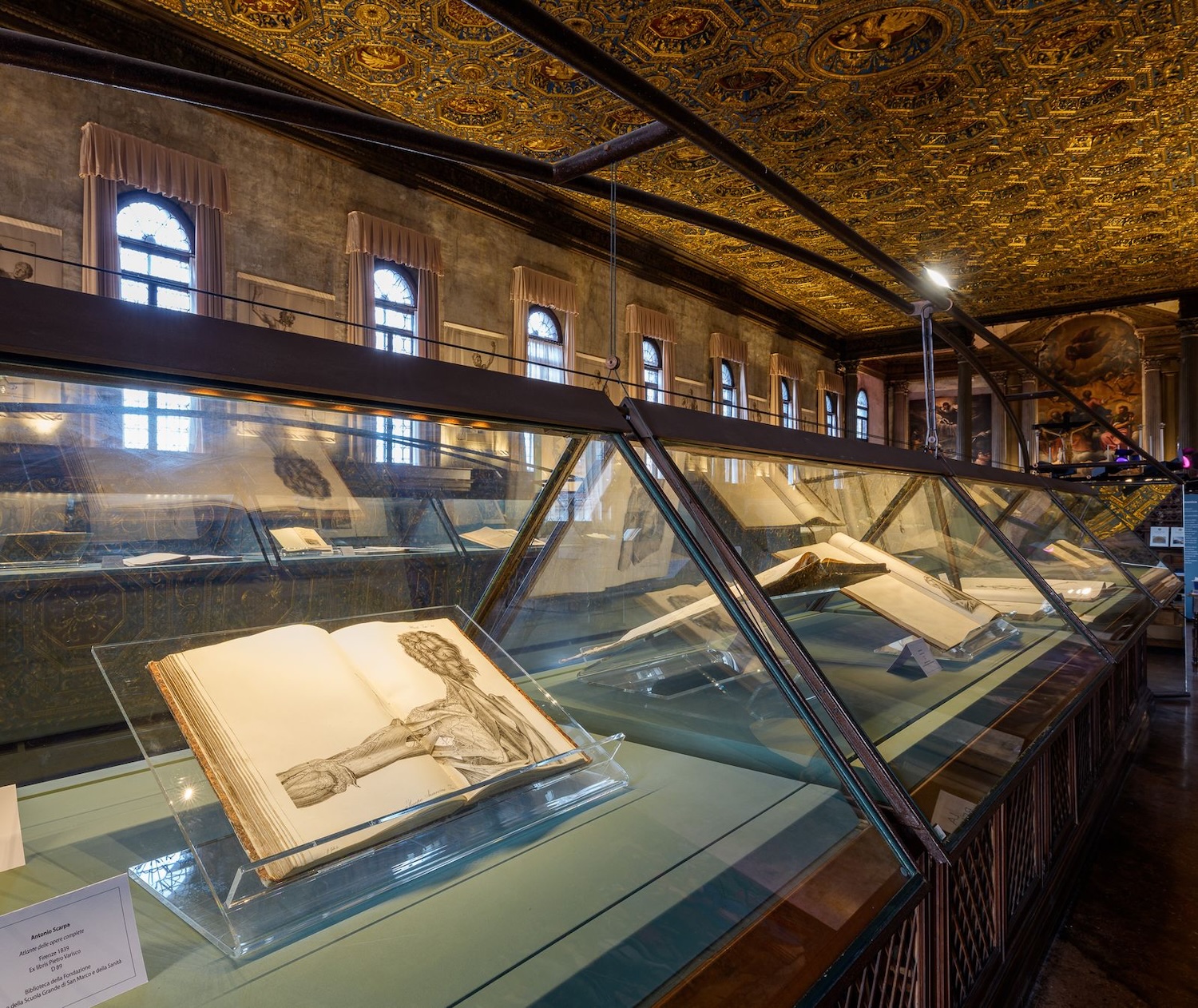
The exhibition highlights how Venice boasts an anatomical tradition dating back at least to 1325, when regulations were introduced requiring the participation of doctors, surgeons and other professionals in dissections. Over the course of six centuries, there were more than thirty locations across the city where anatomy was practised, ranging from hospitals to convents, culminating in the establishment of the anatomical theatre of San Giacomo dell’Orio: a history that has earned Venice the nickname ‘Urbe anatomica’.
From 1500 onwards, this scientific vocation was complemented by a publishing tradition. For over two centuries, Venice was one of Europe’s leading centres of printing, contributing to the dissemination of medical and anatomical works. A significant contribution came from Lucantonio Giunta the Elder and his heirs, who published over fifty medical works in Venice, in which anatomy featured prominently. His son, Lucantonio Giunta the Younger, printed Juan Valverde de Hamusco’s *La anatomia del corpo humano* in 1586. The Italian edition is notable for four famous plates dedicated to the musculature, engraved by Nicolas Beatrizet from drawings attributed to Gaspar Becerra, an artist associated with Michelangelo’s circle.
The connection between the Giunta family and Valverde’s anatomical works continued with the second Latin edition of *Anatome Corporis Humani*, published in 1607: ‘It features a chalcographic title page depicting St Mark’s Basin and the Public Granaries of Terranova, which also housed the Health Magistrate’s Office, a sign of the importance Venice held in the study and practice of anatomy,’ Capitanio points out.
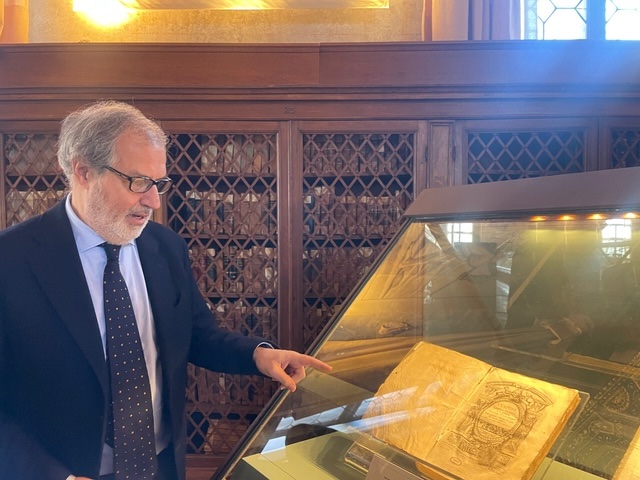
Among the curiosities on display are animated anatomical charts created using overlapping movable flaps: a sort of precursor to pop-up books that not only showed what lay within the body’s entrails but from which the internal organs could also be extracted, simulating a dissection much like in the game Allegro chirurgo. In Italy, volumes of this kind were printed in Venice in 1539 by the printer Giovanni Antonio Nicolini da Sabbio at the request of Giovanni Battista Pederzani; they comprised two plates dedicated respectively to male and female anatomy: ‘These are the only plates with overlapping movable flaps produced in Italy; furthermore, they are the oldest examples on display in the exhibition,’ emphasises Capitanio. The male figure consists of six flaps; the female figure has seven because the last one shows a foetus in the uterine cavity, the place where life originates. ‘By lifting the flaps of the sheets of paper – that is, the skin layer – one finds the muscular layer, and then the various organs, until one reaches the skeleton,’ explains Capitanio. Andrea Vesalius (Brussels, 1514 – Zante, 1564), regarded as the father of modern European anatomy, included images of organs and systems to be cut out and superimposed onto other figures in the *De humani corporis fabrica librorum epitome*, a compendium intended for students published in 1543. Among the volumes with movable flaps on display is the *Catoptrum microcosmicum* by the German physician Johann Remmelin (1583–1632), published in Frankfurt in 1660.
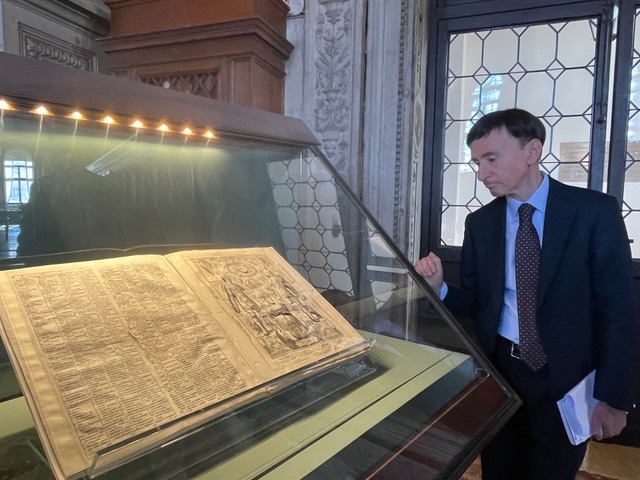
The works on display bear witness to the collaboration between anatomists and artists. In anatomy texts, the human body was, in fact, illustrated by the leading artists of the time. Of particular significance in the exhibition is the figure of the aforementioned Andrea Vesalius, who, at the age of just 23, was appointed to the chair of anatomy and surgery by the Venetian Senate. Upon arriving in Venice, as well as devoting himself to teaching, Vesalius succeeded in establishing a fruitful synergy between the Venetian medical and scientific community, the artistic world and the city’s vibrant publishing scene. Here he met Jan Stephan van Calcar, his compatriot and a pupil in Titian’s workshop, with whom he produced the revolutionary anatomical plates for the treatise *De humani corporis fabrica*, the first anatomical atlas featuring numerous exquisite woodcut illustrations, first published in Basel in June 1543 by his friend Johannes Oporinus. The human figures rendered by van Calcar, who translates scientific knowledge into images, are depicted in poses inspired by classical sculpture, combining anatomical rigour with expressive power. “De humani corporis fabrica” is an innovative work both in its text and in the three hundred illustrations that accompany it. The landscape settings are also highly refined; typical of Venetian art, they have been arranged in the correct order by Giacomo Pistolato, co-curator and coordinator of the Foundation’s cultural activities, and together they recreate a continuous panorama of the Euganean Hills to the south-west of Padua, including Abano and Montegrotto. The name of Andrea Vesalius will appear on the title pages of the Venetian editions only in the posthumous edition of 1604, printed by Antonio and Giacomo De Franceschi and still accompanied by van Calcar’s illustrations. ‘The title page of the edition,’ concludes Capitano, ‘is a manifesto of Venetian identity because, alongside Vesalius, who is performing a dissection, the great Venetian surgeon and anatomist Giovanni Andrea della Croce is also depicted.’