
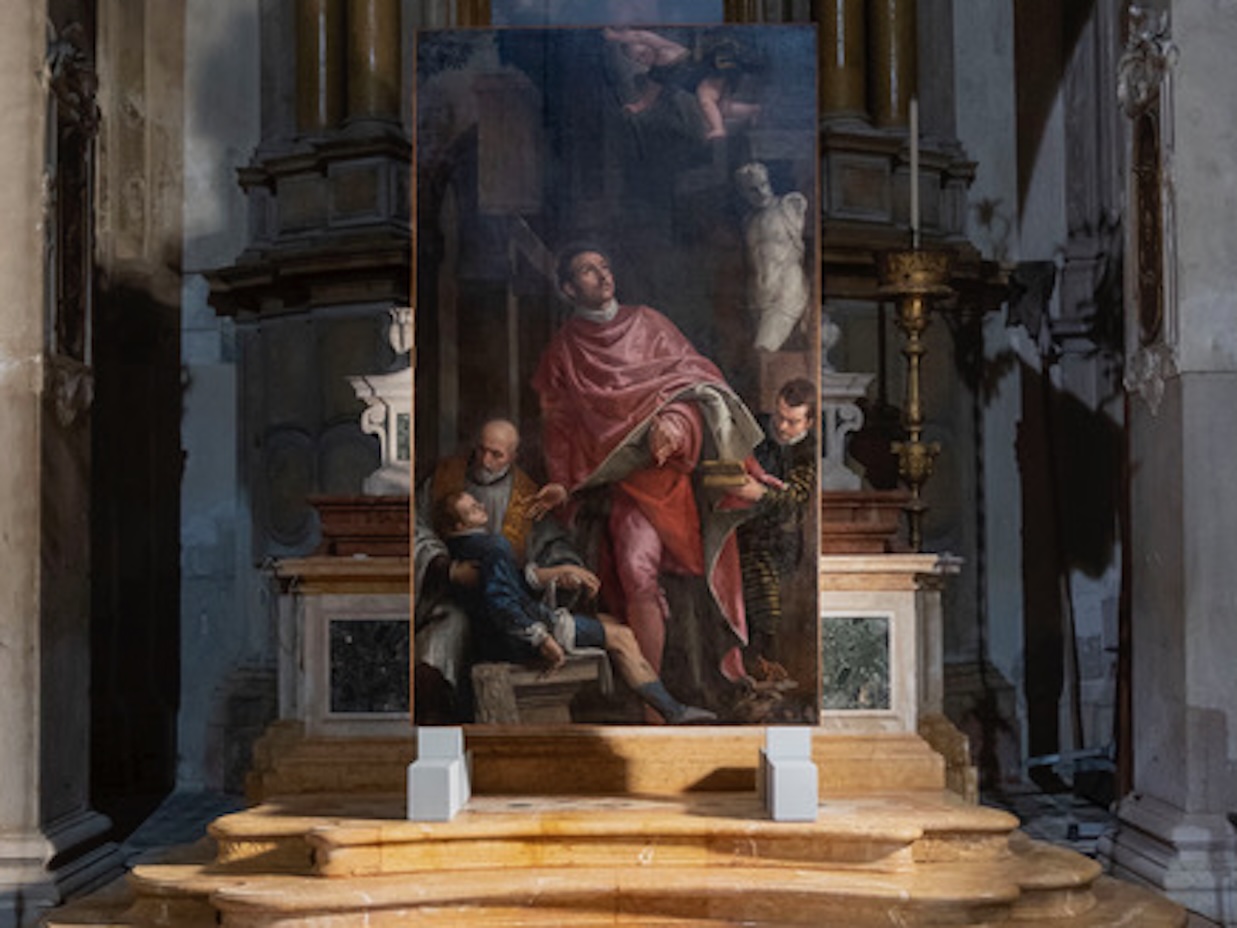
The scene depicts Pantaleon, personal physician to the Roman emperor Galerius, who was originally from the ancient Greek city of Nicomedia in north-western Asia Minor in the 3rd century. Inspired by his encounter with a Christian hermit named Hermolaos, he decided to abandon the traditional tools of medicine and put his faith to the test. Just as a young boy was dying from a snake bite, Pantaleon miraculously managed to bring him back to life through the power of prayer and converted to Christianity.
Veronese was commissioned to paint the work by the parish priest of the time, Bartolomeo Borghi, who is depicted on the left-hand side of the composition holding the dead boy in his arms: the painter reserves a prominent place for the priest in the scene, alongside Saint Pantalon, which was unusual for the time, especially in an altarpiece situated directly behind the altar before which Borghi himself celebrated Mass.
To create the work, Veronese produced a series of studies in a preparatory drawing now held at the Louvre Museum in Paris. The sheet contains several sketches outlining the main groups of figures featured in the final work. The painter devoted particular attention to the figure of Borghi holding the dead boy in his arms, studying this scene from no fewer than three different angles, with the central study – the most finely executed – drawing on the iconography of the Pietà. ‘With speed and dexterity, Veronese creates a veritable portrait of the parish priest with Titianesque vigour’ noted restorer Giulio Bono, renowned for having restored youth and new life to masterpieces such as Giorgione’s ‘La Vecchia’ and Titian’s ‘Pala dell’Assunta’.
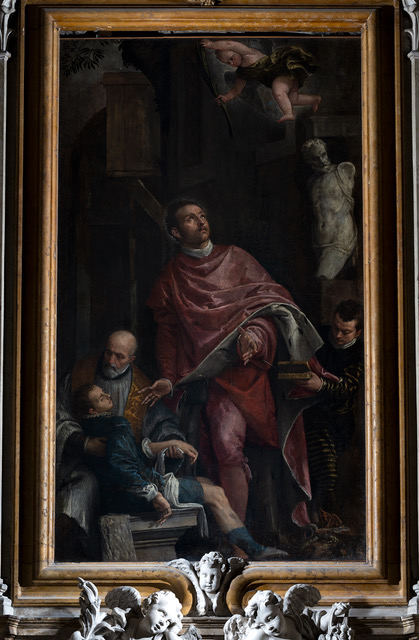
Non-invasive scientific analyses carried out on the artwork in 2024 revealed that the painted surface showed no signs of flaking. However, the use of light and shadow appeared to be absent from the painting, not only due to a build-up of dust – which had to be removed – but also because of an uneven varnish and altered paint restorations, attributable to previous restoration work: ‘The image appeared flat and the sense of depth was lost,’ explained Bono, emphasising that the later phase of the work’s creation was characterised by new expressive explorations, which Veronese translated into increasingly sombre settings, with an apparent lack of dramatic use of light.
During the archival research, information was sought on previous restorations carried out on the work. This led to the 1939 restoration by Rodolfo Pallucchini, the most renowned restorer in northern Italy at the time, which consisted of lining, cleaning and removing old overpainting, particularly in the upper section where the architectural elements had been covered with shades of sky blue. ‘He probably used aggressive substances to correct the blue overpainting, which had turned brown over time,’ explains Bono. ‘Furthermore, Pallucchini harmonised the work with a general tint that creates a golden effect, which was once very common.’ As for Ottorino Nonfarmale’s intervention in 1983, however, the only document attesting to the restoration is the record held at the Misericordia: “There is no further information, however,” Bono adds. From what is known, Nonfarmale also carried out a light cleaning of the existing varnish, applied a new varnish to the painting and re-lined the reverse of the canvas, which is still in a good state of preservation.
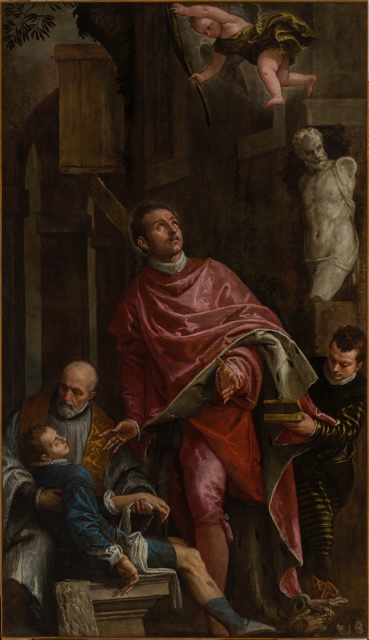
As non-original materials were found, attributable to retouching carried out during previous interventions, the restoration therefore focused on thinning the layers that had deteriorated over time and were causing problems, whilst also attempting to restore the luminosity and the play of light and shadow to the painting, which appeared to be lacking.
In particular, the reflectographic analysis carried out revealed that, beneath the paint layer, the work showed no gaps, tears or rips, but rather widespread micro-abrasions across the entire canvas: ‘The saint’s face, for example, showed micro-abrasions on the chin, whilst the area featuring the cherub was the most abraded and damaged. These were probably caused by overly aggressive cleaning in the past,’ said Bono, explaining that the work carried out with the tip of a brush was fortunately minimally invasive, although it took a very long time as it required many hours to add material. Thus, the atmosphere, the architecture and the fragment of the marble statue of Aesculapius (god of medicine) – which scholars hypothesise Veronese may have seen a fragment of in the Grimani collection – have been rescued from obscurity.
‘In the lower right-hand corner, however, the winged, serpentine figure of a dragon or snake fleeing the scene – previously almost illegible – has gradually been revealed. Veronese’s hand is now once again visible in the painting, demonstrating speed and incredible dexterity,’ explained the restorer, noting how the dramatic brushstrokes and powerful chiaroscuro characteristic of the Renaissance master’s later work have re-emerged in this piece.