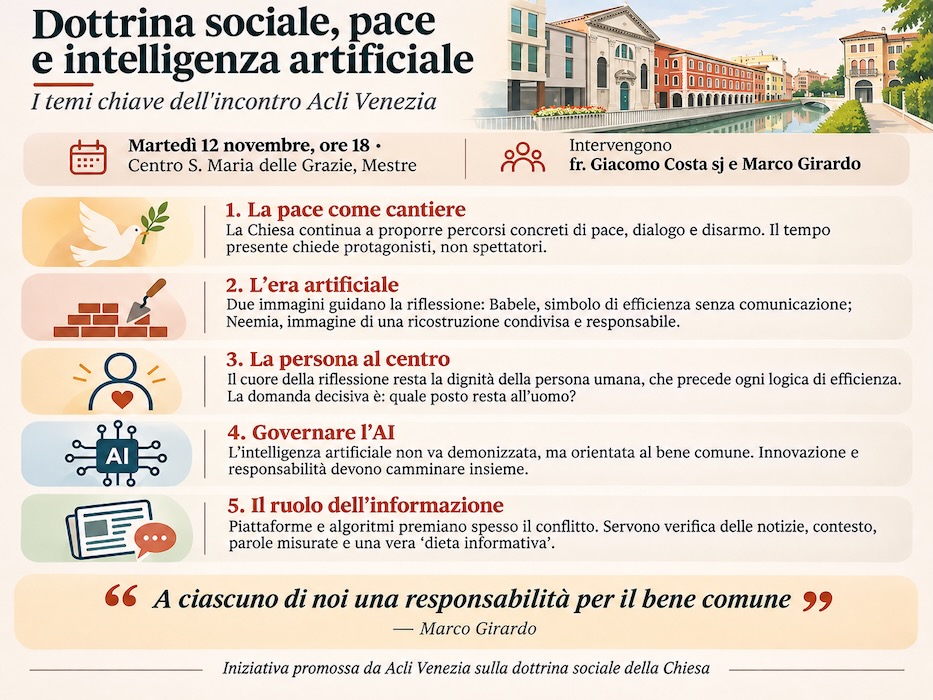
Ever since the Second Vatican Council, it has been a word that refuses to give up. It speaks of peace in a world at war, placing its full trust in humanity as the ‘artificial age’ dawns. The Church’s social doctrine continues to forge a path of dialogue, making its presence felt in the debate – one need only think of *Magnifica Humanitas*. The actual and concrete scope of this voice will be discussed on Tuesday 12 November at 6.00 pm at the Centro S. Maria delle Grazie in Mestre during the second meeting organised by Acli Venezia on the Church’s social doctrine, entitled ‘(The (scant) common) good’, featuring, following an introduction by President Pierangelo Molena, Fr. Giacomo Costa SJ, Undersecretary to the General Secretariat of the Synod, and Marco Girardo, essayist and editor-in-chief of the daily newspaper *Avvenire*.
Marco Girardo, the Pope’s voice seems today to be the only one speaking out on disarmament, within a Church that is the only truly authoritative supranational entity. Is this really the case?
Surprisingly, the word that struck me most whilst reading *Magnifica Humanitas* was ‘worksite’. The model proposed by the encyclicals – first under Francis and then under Leo XIV – is to offer a concrete worksite for building paths to peace. Let us consider Cardinal Zuppi’s mission to Ukraine, and the support given to Cardinal Pizzaballa to ensure that dialogue in the Holy Land continues. Leo XIV invites us to view this era not as spectators, but as active participants.
There are those who speak of an ‘Artificial Age’ and the fear of AI spiralling out of control.
At the beginning of *Magnifica Humanitas*, two models are presented to us. The first is Babel, an efficient, powerful, orderly city dominated by the ambition of the new digital feudal lords – an order that might function but which lacks communion and any reference to the common good. The second image is that of Nehemiah: Jerusalem seen through the eyes of a refugee. Nehemiah observes, prays and listens in a wounded city in need of rebuilding; he assesses the damage and then entrusts each person with a section of the wall, re-establishing a sense of shared responsibility. This is a political image: to each his own section of the wall; to each of us a responsibility for the common good.
Is it really possible to steer the development of AI by encouraging reflection? Is the Pope succeeding in bringing about this reversal of trend?
As the Slovenian philosopher Slavoj Žižek puts it quite well, the crisis of our times is an ecological, economic and social crisis, the effects of which we are seeing these days in the streets, and which is linked to AI and the temptation to regard the human as a resource to be enhanced. The great merit and authority of the message from the Church and the Pope lie in the fact that *Magnifica Humanitas* not only brings these three fault lines together, but also offers readers a clear focal point: the human person, created in the image of God, who possesses an inherent dignity that takes precedence over the demand for efficiency. This is the core and the strength of *Magnifica Humanitas*; it is certainly reductive to treat it merely as an encyclical on AI. In any case, the Pope does not condemn it; he recognises the element of high innovation resulting from human ingenuity, but the fundamental question concerns the place that remains for the human person. One need only think of Palantir and the role that AI has come to play in wars.
In this context, what role does information play?
There is no doubt that in a public sphere characterised by platforms and algorithms, these function better through conflict than through compassion. Conflict is also well-suited to an economy that monetises our attention and seeks the most effective means of keeping us glued to the platform.
Avvenire often stands out as a voice that breaks the mould. What is the secret?
To be informed, you have to want to be. And you have to consider where you get your information from, who you trust; you need to adopt an ‘information diet’ – there is also a responsibility on the part of those who receive the news. For those who produce the news, however, this responsibility translates into a method, starting with the first and good old rule of journalism: verifying the news, because so much of it today is false or fabricated. And then there’s the need to put things into context: if you follow the mainstream media, you might think we’re raising a generation of vandals and are at the mercy of crime, whilst in reality crimes against the person are on the decline. Thirdly, choosing the right words. To avoid news that excites and incites, we must not use words such as ‘alarm, emergency, invasion, crisis, boom’, but more measured terms, favouring individual faces over categories, which are far more frightening than people themselves. Foreigners, migrants and the poor are frightening; the lady who comes to our mother’s house to look after her because we can’t manage on our own is not.
Maria Paola Scaramuzza