
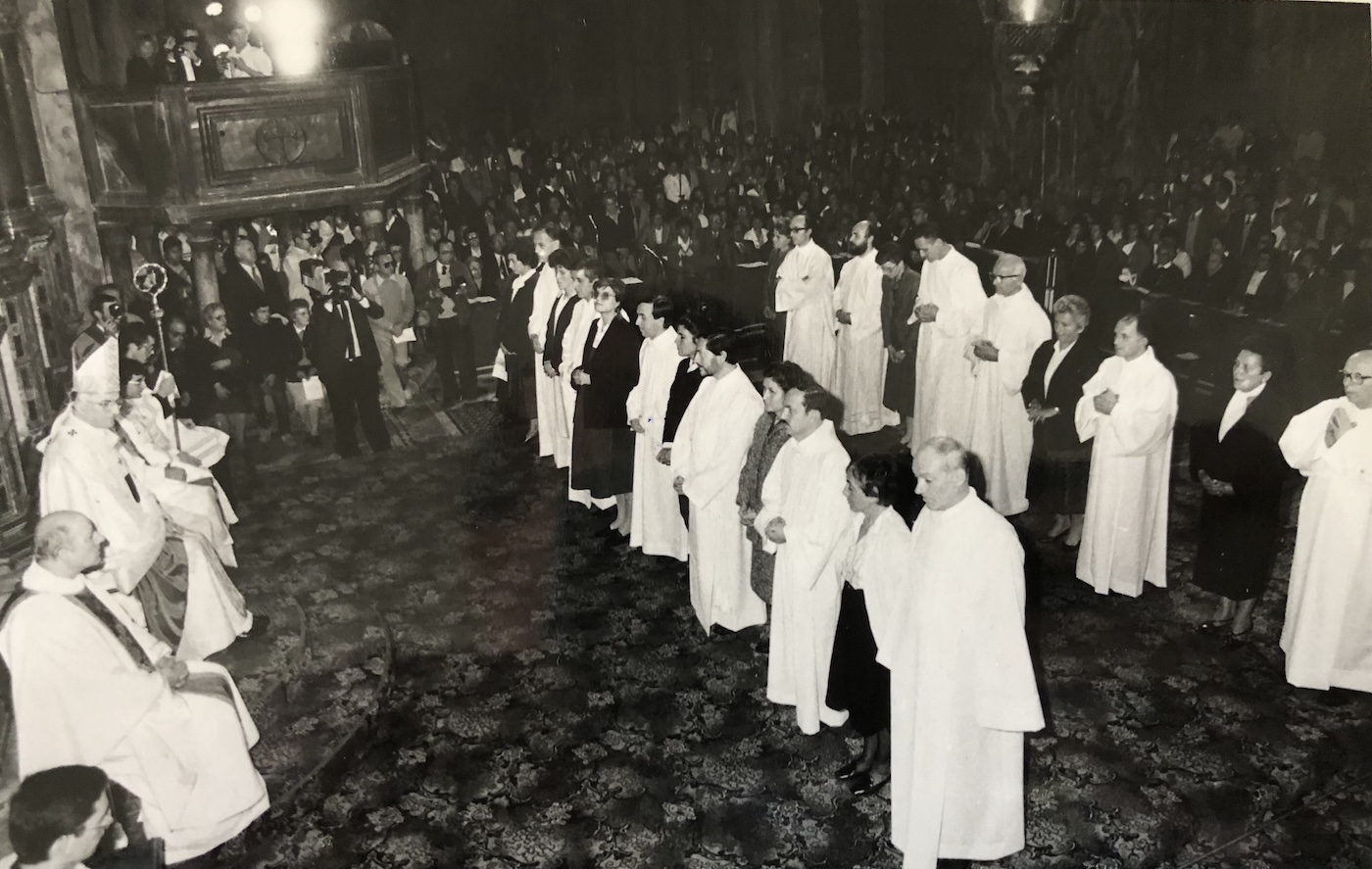
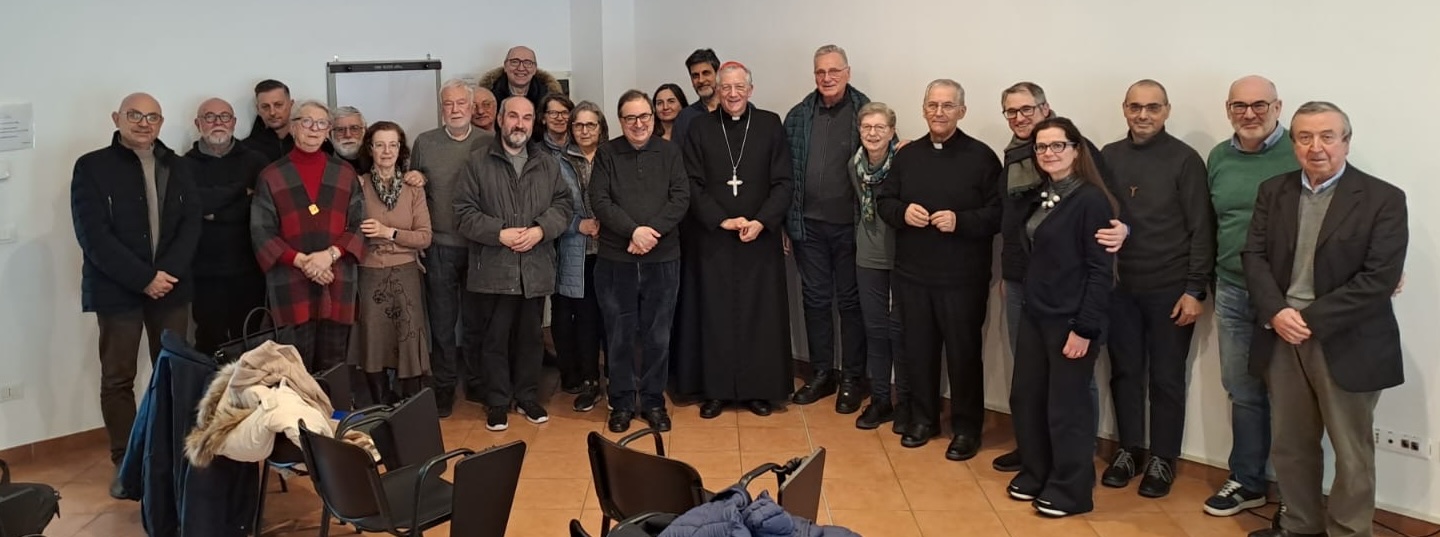
On Sunday, October 18, at 5:00 p.m., Patriarch Francesco will preside over the celebration of Second Vespers at St. Mark’s Cathedral Basilica to mark the 40th anniversary of the reintroduction of the permanent diaconate in the Patriarchate of Venice.
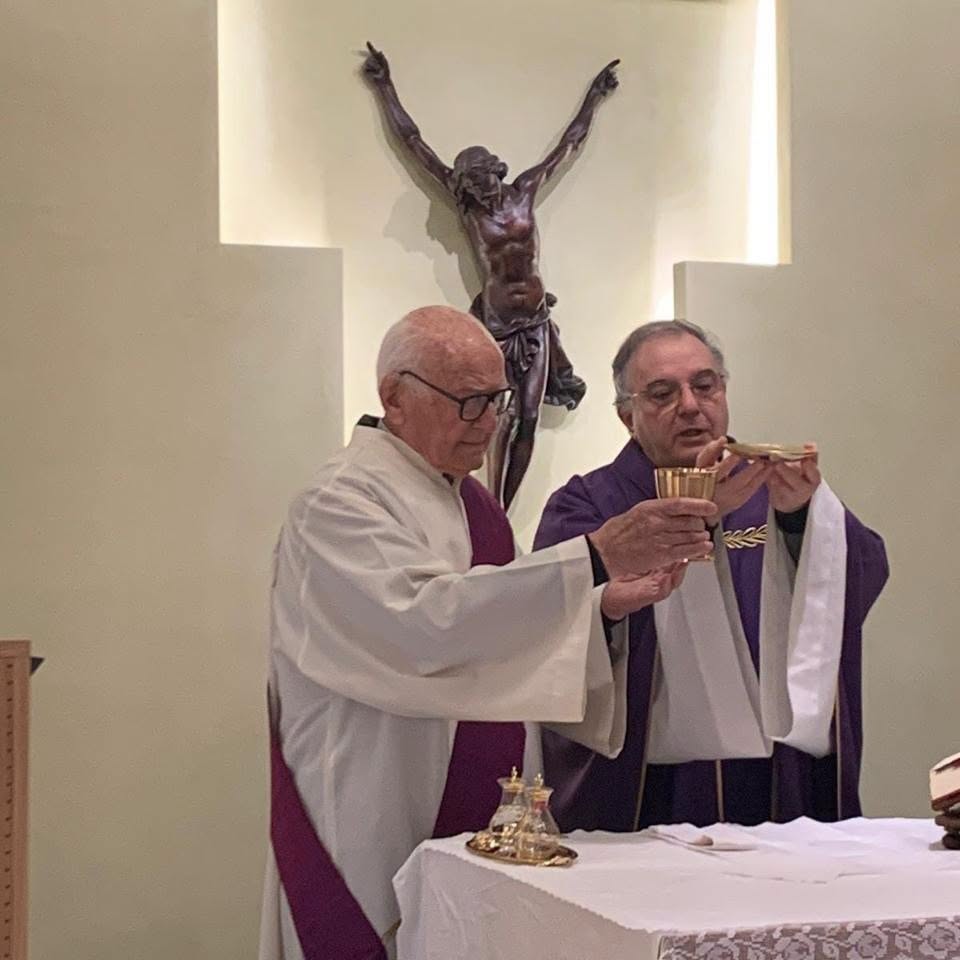
Deacon Giuseppe Pistolato—known to everyone as Bepi—who was a widower with three children at the time of his ordination, passed away just a few days ago. He would have turned 100 on November 17. In the past—even as recently as a few years ago—he had served as a deacon in his parish in Zelarino and in a prison in Venice. For Bepi—who was interviewed just a few days before his death—the five years of formation and preparation for the diaconate were a “time of falling in love with the Word and with Charity.” “Patriarch Marco Cè’s invitation, conveyed by Father Piero Lucchetta, asked me to accept this invitation to attend this course on a trial basis. I responded with my ‘yes,’ which I then repeated on the day of my ordination.”
Deacon Tiziano Scatto, secretary of the Diaconal Community, is the only one of the twelve ordained 40 years ago who remains unmarried, and this is how he recalls that ecclesial event. “Forty years have passed since that October 18, 1986, when, in a packed St. Mark’s Basilica, Cardinal Patriarch Marco, with tears in his eyes, ordained the first 12 deacons to the permanent diaconate. The formation and discernment process lasted five years; at the beginning, there were as many as 54 couples, but as time went on, a process of discernment took place, and in the end, 12 of us remained: ten married men, one widower, and one unmarried man. Some had a college degree, some a high school diploma, and some a middle school diploma; all had jobs and professions and young children to raise. All of us were aware that we were embarking on something new for the Venetian Church, for our parishes, and for the presbytery—which had not always been open to this ministry: the issue of married deacons was somewhat problematic. I remember it as if it were yesterday, when, after the ordination, Patriarch Marco handed me the missio canonica (which every deacon receives in accordance with Canon Law) and which consists of the mission that the bishop entrusts to every ordained cleric. He told me: “You’ll have to break down doors, tear down walls; it will be exhausting and you’ll get hurt, because the diaconate is a beautiful innovation, willed by the Spirit and by the Council, but not everyone understands or wants it. Yet we must obey the Spirit.”
“Who is the deacon?” Scatto asks himself. “What does he have to say to the whole Church?” “The deacon does not do something; rather, he is: he is, in the Church and in the world, the sign of Jesus the Servant, and he shows the whole Church that everyone’s task is to serve according to the example of Jesus, who is among us as the one who serves.” The deacon embodies the face of a Church that is born and renewed by the Gospel as it is proclaimed, embodied in loving relationships, and witnessed through actions and relationships that demonstrate authentic humanity and humanization for all. The ministry of deacons is not expressed in presiding over the gathered community, but in the active promotion of a Church of service, a Samaritan Church, which in this world cares for everyone and which demands and walks the paths of justice. To be a Church of the washing of feet, in imitation of Jesus, Lord and Master, who subverts worldly logic and actively opens up a new way of relating.”
Deacon Sergio Sabbadin recalls how “with great trepidation, in 1986, I was ordained a deacon for the Church in Venice. Forty years ago, I wasn’t fully aware of what it meant to be a deacon, since I had no role model to follow. I placed my trust in the Holy Trinity. I was 36 years old and already had two children: Gilberto, who was 8 (and later became Father Gilberto), and Giovanna, who was just 2. My wife, Ivana, played a decisive role in my journey of formation for the diaconate. I worked as a nurse. Patriarch Marco entrusted me with the task of serving in the parish where I lived, S.M. Ausiliatrice della Gazzera. Subsequently, Patriarch Angelo Scola entrusted me with a new assignment: for the past fifteen years, I have served as a religious assistant at the Ospedale dell’Angelo in Mestre and am part of the small chaplaincy community, which strives to provide the invaluable service of visiting hospitalized patients and their relatives. I have been reappointed to this role of religious assistance by Patriarch Francesco.”
Recalling the homily—with its prophetic tone—delivered by Patriarch Cè on the occasion of the ordination of the first 12 permanent deacons in our diocese, Sabbadin emphasizes “the exhortation not to be afraid, and furthermore: ‘Remember that the Spirit has no limits and no boundaries, and that your diaconal ordination will always accompany you and must make you a sign of God’s love and of a Church that is “sent and serving” the Gospel for the salvation of humanity.’” “With all my limitations and shortcomings, I have tried to keep this exhortation in mind, knowing that I am not alone, but under the powerful guidance of the Holy Spirit and His Holy Church.”
Deacon Antonio Sinatora, reflecting on the forty years that have passed since the permanent diaconate was introduced in the Diocese of Venice, recalls “the kind-hearted Patriarch Marco, who was truly a father to the first twelve men called to the ministry, supporting them throughout their formation with his constant presence, particularly during the spiritual exercises. The six years of preparation were a precious time, not only for studying the disciplines related to the ministry, but also for the beautiful fellowship that formed among the families of the future deacons. I also remember it, however, as a time of spiritual struggle marked by the emergence of doubts, certainties, and uncertainties—a time to learn to fly with the unfailing help of the various teachers and the Patriarch through that guiding hand ever ready to correct and encourage. The ordination ceremony was truly beautiful; it adorned St. Mark’s Basilica in festive attire, as it filled with the faithful from various communities—a celebration felt particularly deeply by those who believed in the diaconate as the completion of the ordained ministries. After the ordination, I was confirmed in my service to the community of St. Lawrence the Martyr for the areas of catechesis, liturgy, and charity—responsibilities I had already been carrying out for years, with the help of my wife in regard to catechesis for children and young people. Forty years—a long period rich in human and spiritual joys, as well as times of hardship and sacrifice that involved the entire family, yet one marked by great serenity.”
Deacon Matteo Bognolo has always carried out his parish ministry at the Lido of Venice, from the original parish of St. Anthony to that of St. Elizabeth. In an interview a few years ago, as he recalled his ordination, what immediately came to mind was that “Patriarch Marco had warned us that the first ordination would be a bold undertaking and that no one could know how it would turn out… An enlightened formator used to tell the deacons in formation: ‘Spend more time at the church door and less time in the sacristy.’ I am glad to have carried the cross over the past years, and as far as the diaconate is concerned, I see a bright future, because Patriarch Francesco has reopened the path.”
After his ordination, Deacon Gino Cintolo was confirmed to continue his catechetical ministry at the Parish of the Resurrection in the Cita neighborhood of Marghera, where he has lived since 1971, and he recalls that, due to the expected birth of their second child in early December 1986, it was not possible to schedule his ordination for the Feast of the Immaculate Conception, as had initially been planned: “The simultaneous arrival of the diaconate and our second child in the family forced Paola and me to find a new balance, which was not always easy.” And here a passage from Patriarch Marco’s homily at the ordination of these first 12 deacons comes to mind: “For those whom the Lord has called through the Sacrament of Matrimony, their wives have also expressed their support for their husbands’ choice, thus affirming—in accordance with the Church’s teaching—the conviction that, with the help of the Lord and the sacraments, the gift of the diaconate will not negate but rather confirm the grace of their marriage”.