
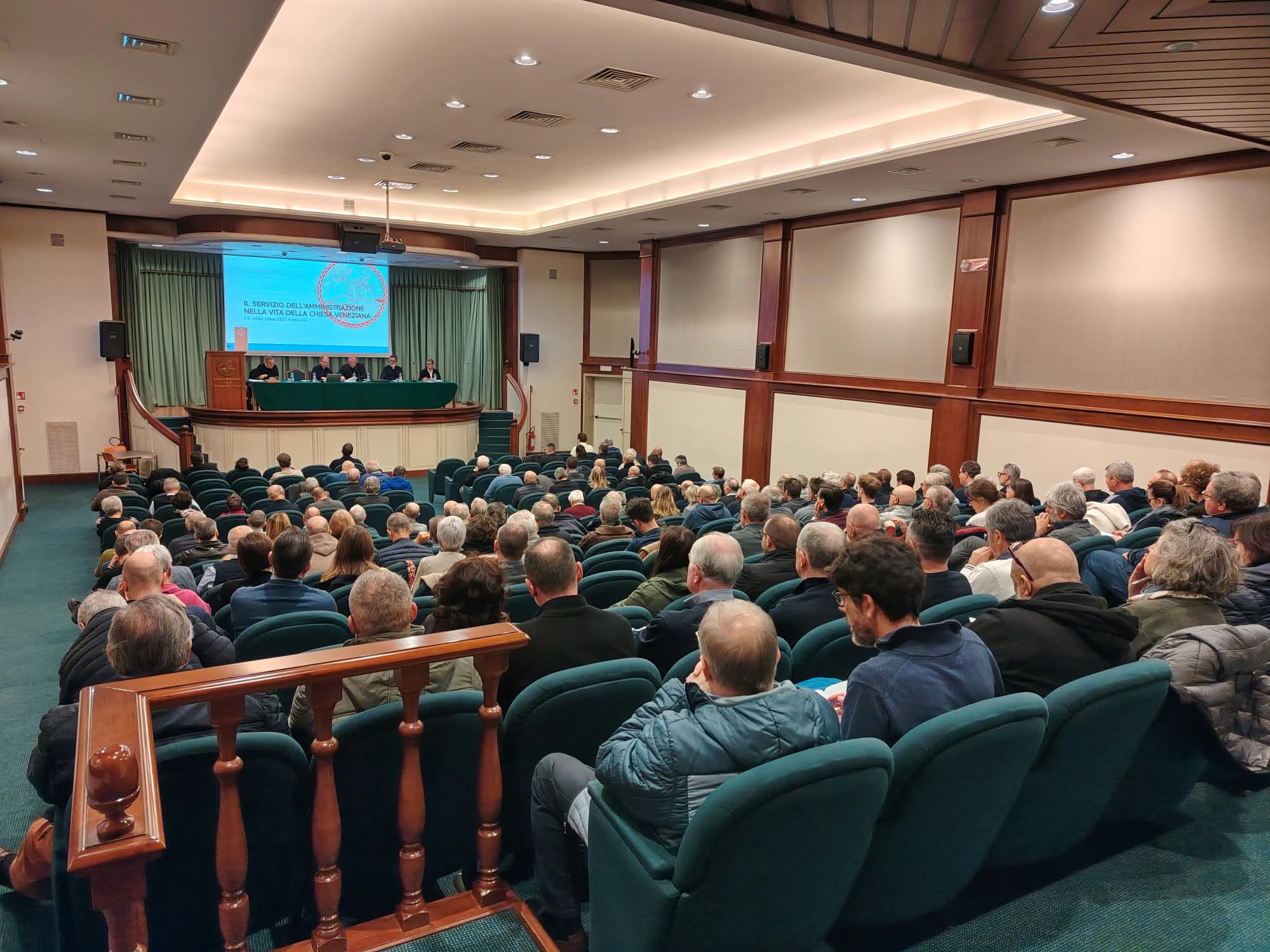
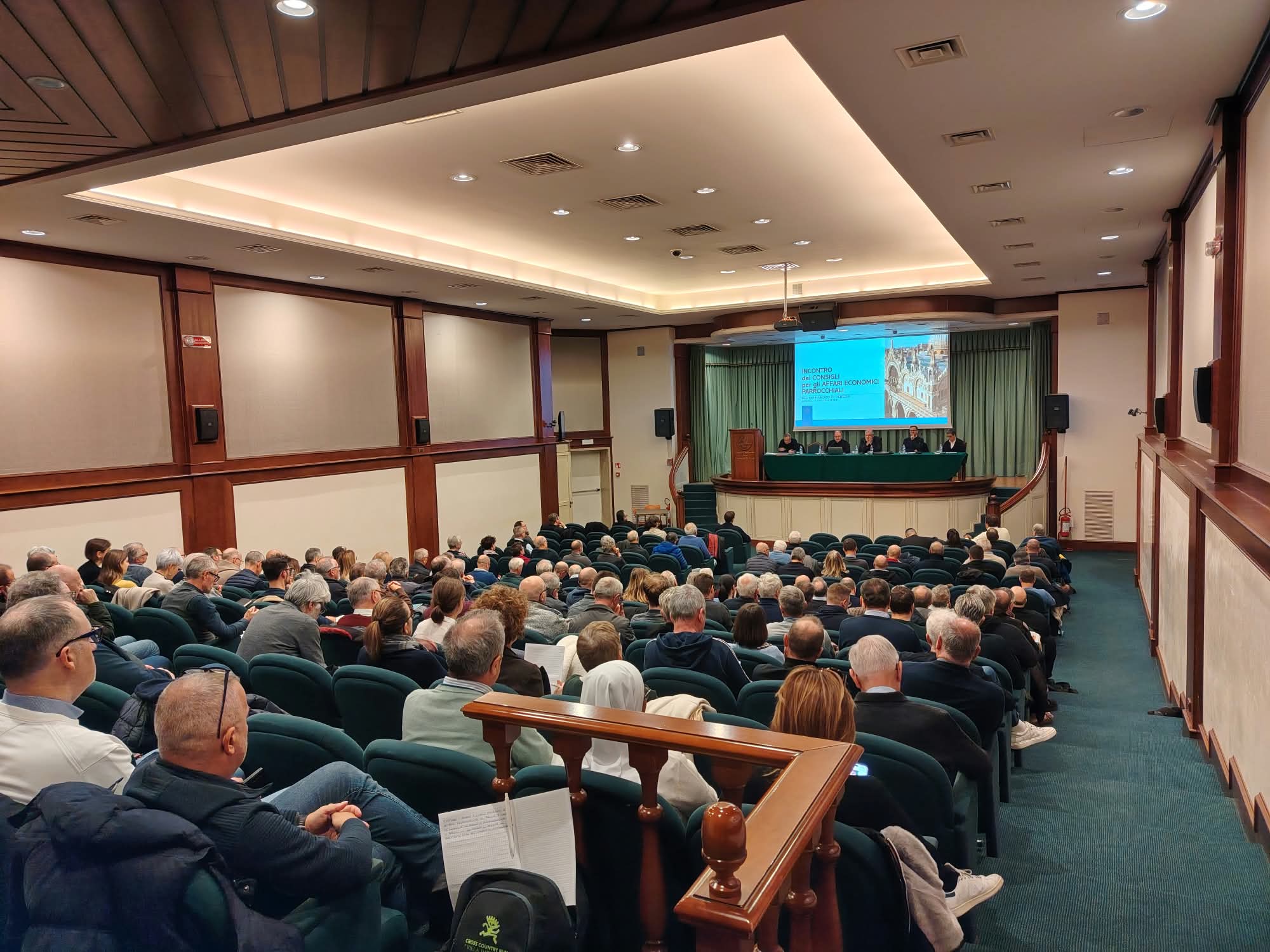
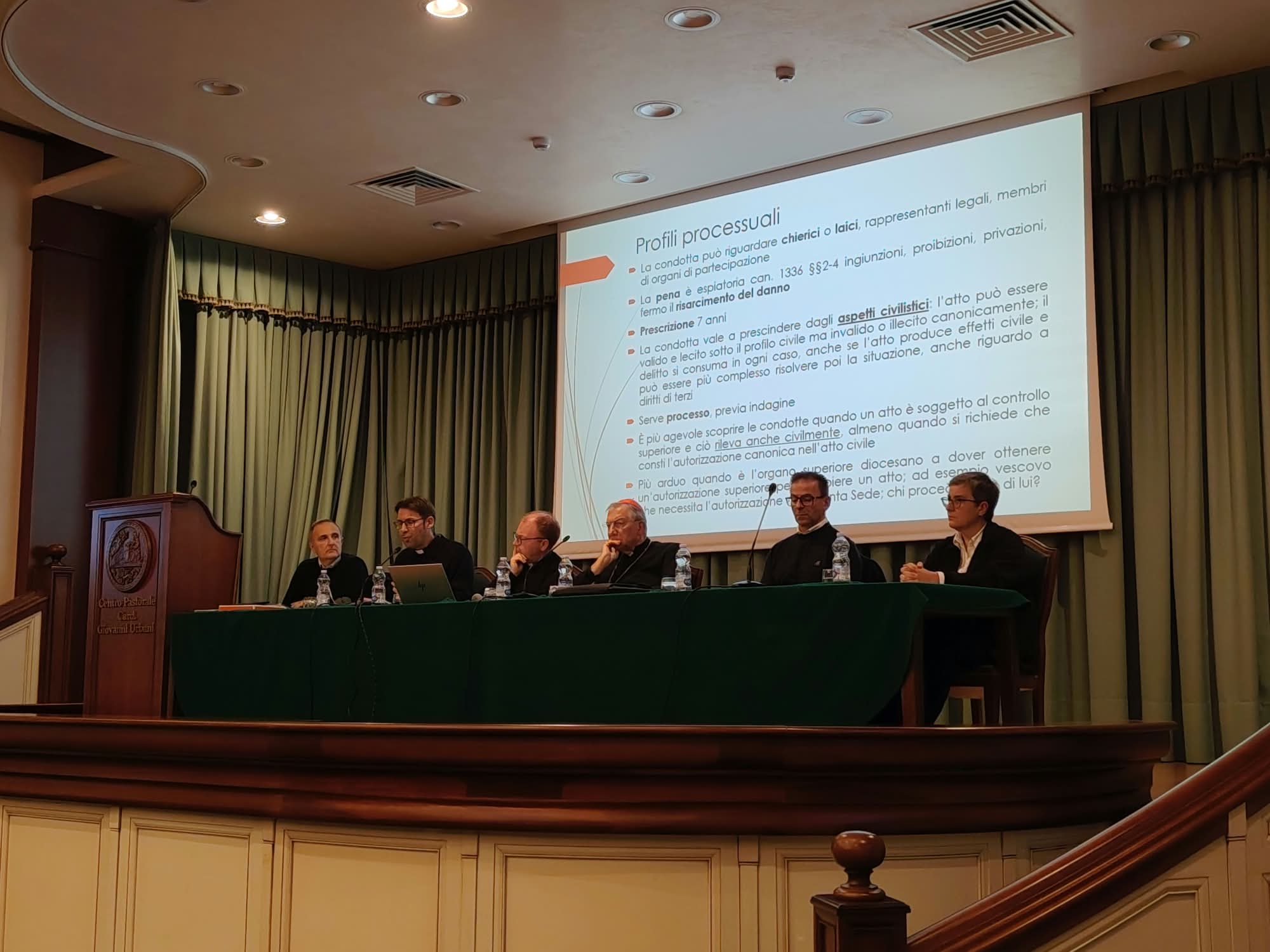
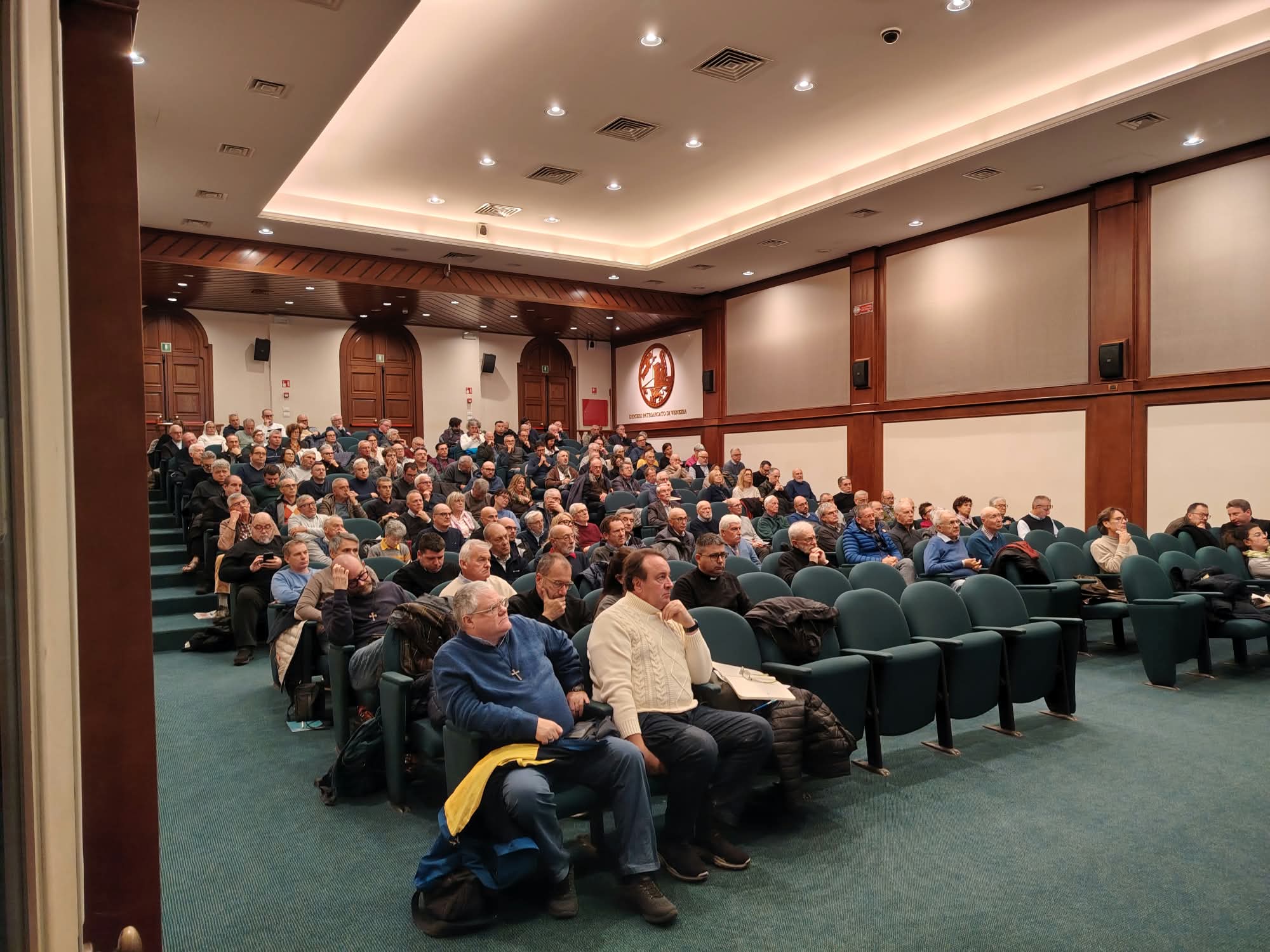
‘Dear friends, we are here for the meeting of parish priests and the parish finance committees. This is the second year that the Diocese – through the Episcopal Vicar, Monsignor Fabrizio Favaro, whom I would like to thank – has organised this event, which we hope will increasingly become a regular fixture. We are, in fact, aware that the management of the Church’s assets is not a marginal issue, nor can it be regarded simply as a technical or administrative aspect of the life of our communities.
I shall begin with a fundamental point: these assets are entrusted to the Church for a mission and must therefore always remain at the service of the Church’s mission. We are not, in a personal sense, the owners of what we administer. We are called to safeguard, administer and pass on a heritage that predates us and which must continue to serve future generations.
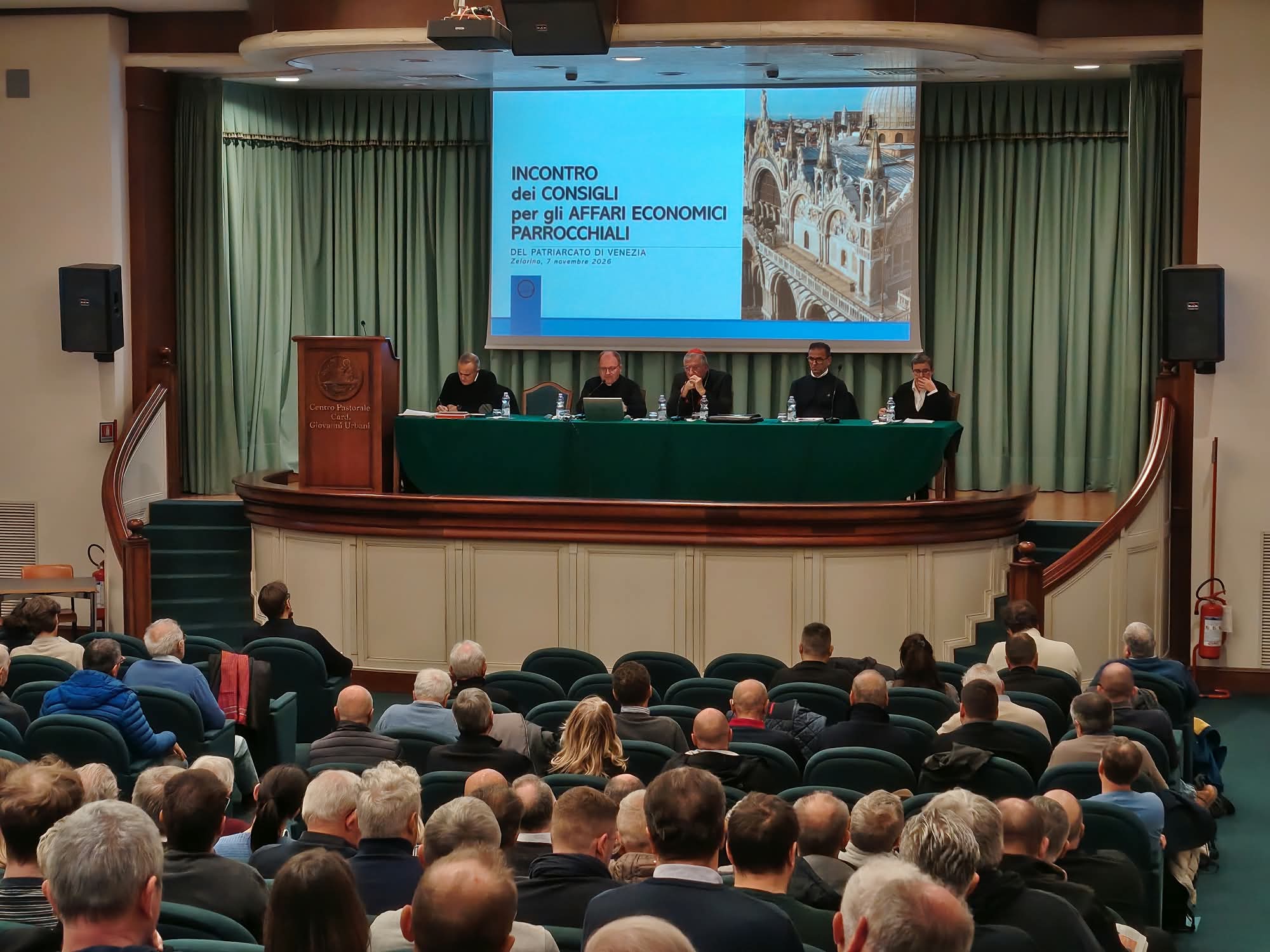
This awareness must guide both the parish priest and the members of the parish finance committees.
I would like to place this reflection within a theological and biblical framework. The first point concerns the mystery of the Incarnation. Christianity is not a religion that despises the material world or regards material realities as an obstacle to the spiritual life. On the contrary, it springs from the proclamation of a God who became man, took on our flesh, entered into history and dwelt tangibly amongst us.
The Incarnation teaches us, therefore, that the material world can become a place where God’s presence is manifested. This has important implications for the way we regard ecclesiastical property. Churches, buildings, works of art and spaces set aside for pastoral life are not merely material realities: in their ecclesial purpose, they can become means of encountering God, of communion and of passing on the faith.
We must not set the spiritual dimension against the material one. Rather, we must understand how the latter is called to serve the former. The Church, in fact, does not exist outside history and cannot disregard the material conditions through which it carries out its mission. It needs places to celebrate, it needs facilities to educate in the faith, it needs spaces and facilities to support charity, and it needs tools to proclaim the Gospel.
This does not mean attributing an absolute value to material goods. It means recognising that their importance depends on a well-founded and shared pastoral purpose which they are meant to serve. The essential reference point is ecclesial sharing.
From this perspective, the words of Saint Paul in his First Letter to the Corinthians are particularly enlightening. In chapter 3, the Apostle states: ‘Everything belongs to you! But you belong to Christ, and Christ belongs to God’ (1 Cor 3:21–23).
This is a statement of great depth. Everything is yours, but not in the sense of arbitrary, individualistic or unlimited possession. Everything is yours because you belong to Christ. And it is precisely this belonging to Christ that changes the way we relate to things.
Christian ownership is never absolute: it is always relative to the lordship of Christ and to the intended purpose of those goods.
A second passage, even more directly linked to our reflection, is 1 Corinthians 4:1–2. Paul writes that people should regard us as ‘servants of Christ and stewards of the mysteries of God’, and adds that stewards are required to be found faithful.
The key term here is precisely ‘stewards’. We are not absolute masters, but people to whom something has been entrusted. Faithfulness consists in recognising the meaning of what we have received and in safeguarding it in accordance with its intended purpose. This principle applies not only to the Church’s spiritual goods but also to its temporal ones.
To administer means to be faithful to a mandate and a trust that have been entrusted to us at the ecclesial level. It is not merely a matter of preserving an inheritance, but of recognising that it is intended to support a mission which does not coincide with our personal preferences, our tastes or hobbies, nor with the demands of the moment.
When we speak of ecclesiastical assets, we must bear in mind that we are not merely referring to property, land, places of worship, pastoral facilities, works of art, financial assets or economic resources. Whilst all these assets certainly have a material and economic dimension, they also serve a spiritual purpose.
A parish building is not merely a property; a church is not merely an architectural asset; a plot of land is not simply a property to be exploited for financial gain. These are realities that have become part of the history of a Christian community and are intended to sustain its life and mission.
The fundamental criterion is not merely how much an asset is worth, but what purpose it serves and what responsibility it entails. This does not mean disregarding the economic value of assets or underestimating the requirements of their administration. It means placing every economic assessment within a broader perspective: that of the Church’s mission.
The Church possesses assets, but she does not live for her assets. She administers them so that they may support the celebration of the sacraments, the proclamation of the Gospel, the life of the communities and the service of charity.
The parish priest, together with the Council for Economic Affairs, is called upon to exercise a responsibility that cannot be delegated solely to the technical expertise of a professional or a consultant. Technical expertise is indispensable, but it is no substitute for ecclesial responsibility.
The parish priest has a responsibility of his own, which must be exercised in communion with the participatory bodies and in accordance with canonical and civil provisions.
The Council for Economic Affairs is not a purely formal body, called simply to ratify decisions that have already been taken. It is a valuable instrument of shared responsibility, evaluation and advice. For this reason, it is important that its members are able to make a genuine contribution to decision-making by bringing to bear their professional expertise, experience and knowledge of the local area. Shared responsibility, however, must not lead to confusion over roles. Everyone must know their own task and take responsibility for it.
Good administration stems from the combination of competence, transparency and an ecclesial mindset. It is not enough simply to be people of good will. It is necessary to adopt the right administrative mindset, to be familiar with the regulations, to plan actions and to know how to seek advice when situations require it.
I would like to focus on some passages from the Letters to the Corinthians which, in my view, offer very practical guidance for our ministry today as well. It is significant that Saint Paul does not confine himself to setting out spiritual principles, but also goes into the practical details of how the communities’ financial resources should be managed and collected.
First of all, in 1 Corinthians 16:1–3, Paul gives precise instructions for the collection in aid of the Christians in Jerusalem. He asks that, on the first day of every week, everyone should set aside whatever they can, according to their means, so that the collection need not be organised at short notice upon his arrival. He also specifies that the sums collected should be entrusted to people recognised by the community and accompanied by letters of introduction.
This is a very interesting passage, because it shows that even in the apostolic Church, solidarity was not left to chance. Generosity requires organisation; charity does not preclude administrative precision; indeed, it demands it.
Paul wants the offerings to be collected in an orderly manner, for people’s means to be respected, and for there to be proper procedures for their delivery and allocation. We are not, therefore, faced with a conflict between spirituality and organisation. Christian charity itself requires seriousness, planning and responsibility.
A second, even more explicit passage is found in 2 Corinthians 8:18–21. Paul, speaking of the organisation of the collection, reports that he chose co-workers recognised by the churches and entrusted with overseeing the management of the offerings. And he adds a particularly important reason: ‘For we are careful to act honourably, not only in the sight of the Lord, but also in the sight of men’ (2 Cor 8:21).
Here we find a principle that remains as relevant as ever. Administrative integrity must be genuine and must also be recognisable, visible to all. Good intentions are not enough: procedures must be transparent and adhered to; responsibilities must be clearly defined; and operations must be verifiable.
Transparency is not merely a matter of good administration: it is a form of Christian witness. The Church must be able to demonstrate that the resources entrusted to her are administered with honesty and responsibility. Not to seek the approval of people, but because fidelity to the Gospel also demands blameless conduct before the community.
This instruction from St Paul directly challenges the way we administer our affairs: accounts must be accurate, documentation must be kept, decisions must be properly justified, and responsibilities must be clearly identifiable. The offerings of the faithful, donations, contributions and other financial resources are not the personal assets of the parish priest or of those involved in administration; they are resources entrusted to the community to support worship, pastoral life, charity and the needs of the Church.
Transparency protects everyone: the parish priest, the members of the Parish Council, the faithful and the ecclesial community itself.
There is another passage from the Second Letter to the Corinthians that I would like to refer to, as it enables us to round off this discussion. In 2 Corinthians 9:6–15, Paul sets out a genuine theology of generosity.
The Apostle reminds us that whoever sows sparingly will also reap sparingly, and whoever sows generously will also reap generously. But, above all, he states that each person must give according to what they have decided in their own heart, not with reluctance or under compulsion, for ‘God loves a cheerful giver’ (2 Cor 9:7).
It is important to understand the meaning of these words clearly: Paul is not simply calling for more offerings to be collected. He is showing that generosity is an expression of the Christian life, a fruit of the grace received.
God himself is the one who gives and makes human generosity possible. The wealth of the community is not measured solely by the size of its financial resources, but by its capacity to share and to transform the goods received into works of charity.
Paul adds that God is able to make every gift abound, so that we may carry out every good work (cf. 2 Cor 9:8). And he concludes by showing how generosity bears a twofold fruit: providing practical help to those in need and inspiring thanksgiving to God.
This is the most beautiful aspect of the text: generosity is not limited to the good that is done, but also becomes praise to God.
Offering and financial resources, when used in accordance with the Gospel, become means through which communion is manifested, the poor are helped, and thanks are given to the Lord.
This helps us to regard the offerings of the faithful with great respect. Behind every contribution – however small – there may lie sacrifices, renunciations and a genuine sense of belonging to the Christian community. We must never take people’s generosity for granted. We must cherish it, respect it and make it bear fruit.
At the same time, we must educate our communities in a conscious, free and joyful generosity, which is not reduced to a financial request, but springs from participation in the Church’s mission.
The true wealth of a community lies not only in what it possesses, but in what it is able to give and share.
Another important responsibility concerns the preservation of our heritage. We cannot limit ourselves to taking action only when an emergency arises. We need to develop a mindset focused on prevention, planning and maintenance.
A church, a vicarage, a parish building or a pastoral centre requires constant attention. Allowing a property to fall into disrepair often means passing on a more serious and costly problem to future generations. But safeguarding does not mean indiscriminately preserving everything without questioning its actual purpose.
We must be able to distinguish between what needs to be maintained, what can be enhanced, what can be repurposed, and what may require more challenging decisions. In any case, decisions cannot be dictated solely by short-term economic convenience. They must be carefully considered, well-founded and taken in accordance with the Church’s regulations and the remit of diocesan bodies.
We have a responsibility towards the past, because we have inherited a heritage often built through great sacrifice and the generosity of many people; there is a responsibility towards the present, because we must use these assets in a way that meets the needs of the community; there is a responsibility towards the future, because we cannot squander or disperse what we are called to pass on.
Safeguarding does not simply mean preserving: it means ensuring that these assets continue to serve an ecclesial purpose.
I would like to highlight one final point, which I consider particularly important: the parish is not an isolated entity. It is part of a particular Church, the diocese, and exists within a communion that also entails a shared yet differentiated responsibility. This means that decisions concerning assets cannot be taken according to a purely individual logic or that of a group formed in a self-referential manner.
The parish priest is responsible for the community entrusted to him but is not the independent owner of parish assets; he acts on the bishop’s authority. Canon law, in particular the provisions of the Code of Canon Law on the administration of the Church’s temporal goods, clearly emphasises the responsibility of administrators and the need to respect the prescribed competences.
It is therefore important to be familiar with the procedures, to comply with the necessary authorisations, and to maintain a proper and ongoing relationship with the relevant diocesan offices.
We must not view these guidelines as obstacles or bureaucratic burdens. They are tools that help to safeguard the community and ensure that decisions are taken with prudence and responsibility.
Here we see the Pauline image of the Church as a body, as presented in 1 Corinthians 12. The various members have different tasks, but they belong to a single body and are mutually necessary. Our parishes too, with their resources and assets, belong to this greater communion.
This does not mean negating the identity and responsibility of individual communities, but rather understanding that the Church’s heritage cannot be viewed in terms of isolation. It must remain open to the needs of the Church and to solidarity amongst communities.
I would like to conclude by returning to the point from which we began: the Church possesses goods, but she does not live for her goods. Her raison d’être is the proclamation of the Gospel, the celebration of the sacraments, the witness of charity and the building of vibrant Christian communities.
The Incarnation reminds us that God took on our humanity and bestowed upon material reality a dignity that we cannot ignore. And Saint Paul reminds us that everything belongs to Christ, that we are stewards called to faithfulness, and that generosity must be expressed through concrete acts of sharing. It also teaches us that charity requires organisation, that transparency is a form of witness, and that a gift given with joy becomes a thanksgiving to God.
These are perspectives that must guide our way of thinking and acting. We must, therefore, avoid two opposing risks: on the one hand, underestimating administrative responsibilities, as if good will were enough; on the other, the risk that administration might become so all-consuming that we forget the reason why we administer.
We must not become stewards of assets that have lost their ecclesial purpose. We must be custodians of a heritage that continues to speak of the Gospel and to serve its proclamation.
I thank the parish priests and all those who – within the Councils for Economic Affairs – offer their time, expertise and willingness to help. It is a service that often goes unnoticed, requiring patience, precision and the ability to tackle even complex issues. Precisely for this reason, it deserves our gratitude and attention.
Our annual meeting is intended to be an opportunity to deepen this awareness, to share responsibilities and to tackle together the issues concerning the heritage of our communities.
‘What we have received is not merely something to be preserved: it is something to be safeguarded responsibly and passed on, so that it may continue to serve the Church and the Gospel.’