


As a further consequence of the deadlock in the decision-making process, the long-awaited operational definition of a target of 120 billion dollars per annum – to be funded and fully implemented by 2035 – for climate change adaptation and to compensate for the losses and damage already suffered (Loss and Damage) – a commitment deemed essential by developing countries, the African Group and island states, which suffer most from the ongoing climate change and are hardest hit by extreme weather events, and which is designed to protect populations, infrastructure and water resources from the growing impacts of the climate crisis.
With the paradox that the outcome of COP31 has been hailed by climate sceptics as, in fact, an opportunity to divert attention from what they regard as an unnecessarily costly energy transition – heaven forbid we should question the race for consumption fuelled by production processes hurtling headlong in a mad dash towards an exponential increase in energy-intensive activities – whilst to many, a more viable investment seems to lie in ‘adaptation’ policies, as if there were no physical limits to the tolerance of environmental parameters, for human life and the ecosystems that sustain it, as if ‘systems’ could simply be adapted indefinitely to progressively different ranges of temperature and atmospheric humidity, or as if the disruption of the circulatory systems that regulate rainfall patterns across the land – already severely compromised – counted for nothing or could be easily offset by ‘adaptation’ policies, which today, more than ever, sound like the tragic rhetoric of a self-serving resignation. And, to add insult to injury, as if adaptation policies – unlike the unmet commitments on mitigation – had come out of COP31 in good shape.
We now know that, given the complexity of the problem, action must be taken on both fronts: mitigation and adaptation are two complementary dimensions of environmental policy: mitigation efforts without adaptation would unrealistically leave the most vulnerable populations exposed to the effects of a systemic disruption that would continue to follow its inertial course regardless, even if we were to cease emitting climate-altering gases immediately; adaptation without mitigation would amount to a dangerous – and politically irresponsible – outlook of resignation, offering no future for the planet, conceivable only in the scientific ignorance of believing that the Earth’s biosphere is indefinitely adaptable in the face of changes of such acceleration and magnitude in environmental parameters.
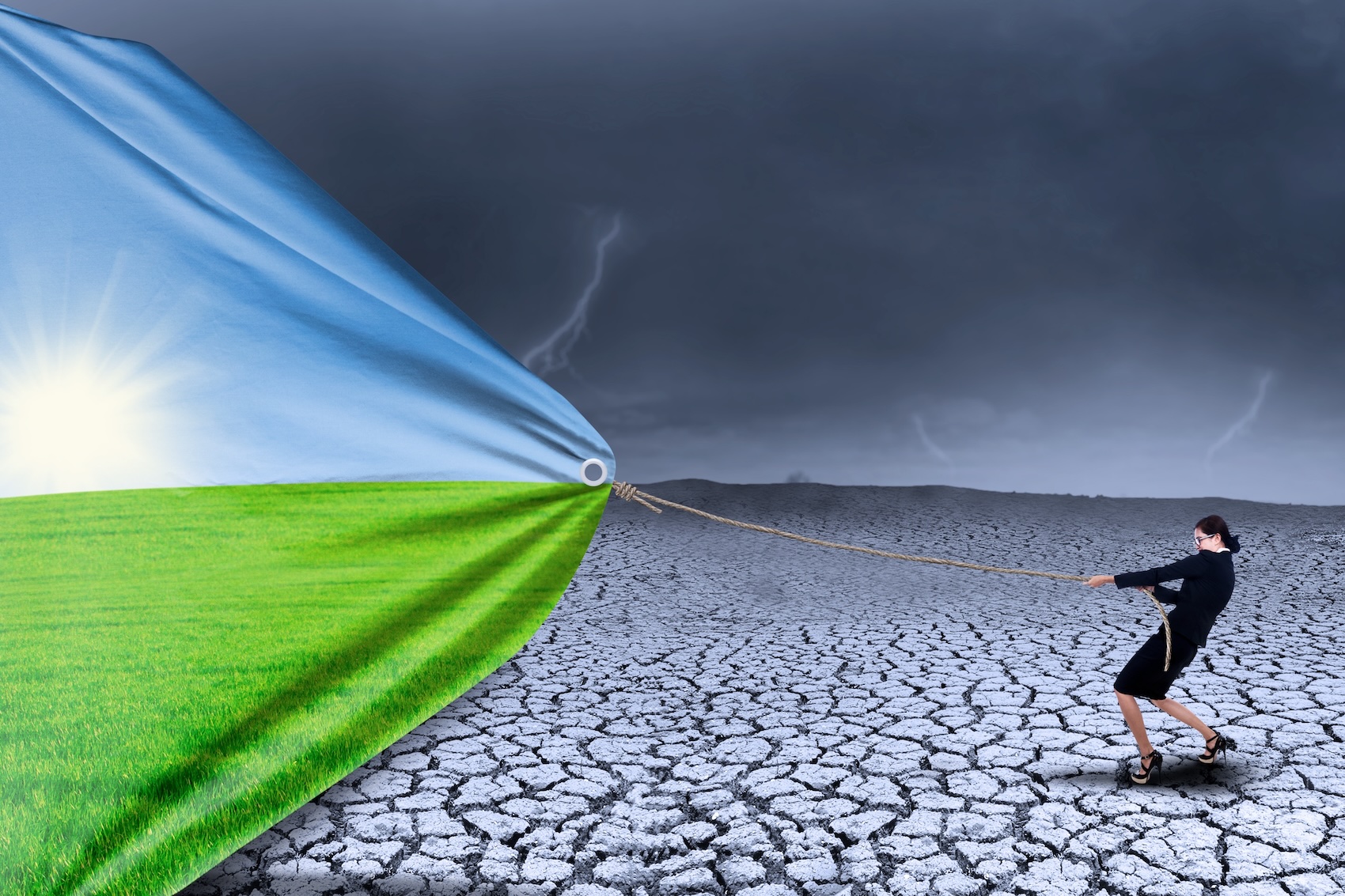
And this failure comes at the end of a year that has seen one of the summers which, through heatwaves and extreme weather events, has most clearly highlighted the profound disruption to the complex global climate system – not to mention the scientific misinformation whose ideological biases fuel the endless repetition of the many mantras that continue to be regurgitated uncritically, from ‘the climate has always changed’ to ‘it’s always been hot in summer’ – and, consequently, the urgent need for effective environmental policies. Not only that: as the situation worsens, according to the Media and Climate Change Observatory, which monitors 131 media outlets (press, radio and TV) in 59 countries, global media coverage of climate change in 2025 has fallen for the fourth consecutive year, recording a 38 per cent drop since 2021, and for countries such as Italy and the United States, a drop of over 50 per cent in coverage on the subject is estimated (-53 per cent in news programmes and -26 per cent in daily newspapers, according to a recent analysis by the Pavia Observatory for Greenpeace Italy).
COP31 was also affected by the diplomatic absence of the United States – which, from 1850 to the present day, has accounted for 24 per cent of global CO₂ emissions from fossil fuels and whose boycott and absence from the negotiations, resulting from the blatantly climate-denying positions of Trump and the MAGA ideology, severely weaken the multilateral process – and the atmosphere created by the recent Shenzhen declaration between Washington, Beijing and Moscow to increase the production and supply of petroleum products.

In light of these disappointing results, at the general audience on Wednesday 25 November, Pope Leo XIV, continuing his meditation on Chapter V of *Gaudium et spes*, dedicated to the promotion of peace, began by stating that God’s plan to ‘become, in Christ Jesus, the family of God’s children’ (GS 92), which calls for the building of a world of peace, is a ‘perspective full of hope’ that ‘aims to embrace not only humanity but also the whole of creation, as suggested in St Paul’s Letter to the Colossians’ (cf. Col 1:20). Following his greetings, he issued an appeal in which he stated that ‘in the face of the increasing frequency of extreme environmental phenomena linked to the climate crisis, it is a cause for concern that COP31 concluded without the international community adopting clear commitments to tackle it seriously and responsibly’, recalling the close connection between this issue and the cause of social justice. Let us not forget, in fact, that the Church’s ‘environmental teaching’, which since the time of Benedict XVI has been significantly expanded and deepened in response to the worsening climate crisis and environmental degradation caused by human activity, is not a floating fragment of environmentalist ideology that has sprung up on a whim within a Church chasing the fashions of the day, but a precise, coherent, systematic and theologically grounded expression of its social doctrine, which cannot fail to address the pressing concerns – as they arise – regarding everything that pertains to human beings, their dignity and quality of life, just as it has always done throughout its history. This helps us to understand the Pope’s words: ‘Let us never forget the human face of the climate crisis, which affects the lives of millions of people, impacts entire communities and jeopardises the prospects of future generations. This situation calls for a renewed sense of shared responsibility: new forms of solidarity amongst nations and fundamental changes in behaviour, in socio-economic systems and in the governance of our societies. I call upon the international community and upon each and every one of us to make a renewed commitment to promoting a culture of care for creation, one that places at its centre the dignity bestowed by God upon every human being, the common good and solidarity with the poorest and with future generations’.

As noted by the Executive Secretary of the UNFCCC, Simon Stiell, the negotiation process nevertheless continues to make progress on several fronts, and some results have been achieved, foremost among which is the signing, by some 80 countries – including the European Union and Italy – the Global Electrification Pledge, with the aim of increasing the share of electricity from renewable sources – as the fastest and most efficient means of decarbonising the manufacturing and transport sectors – to 35 per cent of global final energy consumption by 2035. The text on a ‘Just Transition’ was also approved, aimed at strengthening international cooperation to protect workers and communities affected by industrial and energy transition; this issue is, in fact, one of the key concerns regularly raised as a pretext for political inaction, often with an anti-European slant. Further progress has been made on the indicators for the Global Goal on Adaptation, the Adaptation Fund and the preparation of the Global Stocktake – the report assessing the progress made by individual countries in their respective national plans.
Much remains to be done, therefore, and perhaps what sounds like a failure today could herald a fresh start on a more solid footing, following reflection on over thirty years of uncertainty and delays in international environmental policies. Above all, there remains an urgent need for reliable information, free from the shallows of ideologies of any political persuasion – an essential prerequisite for raising awareness and taking responsible action, with the collaboration of all stakeholders, for the common good.