
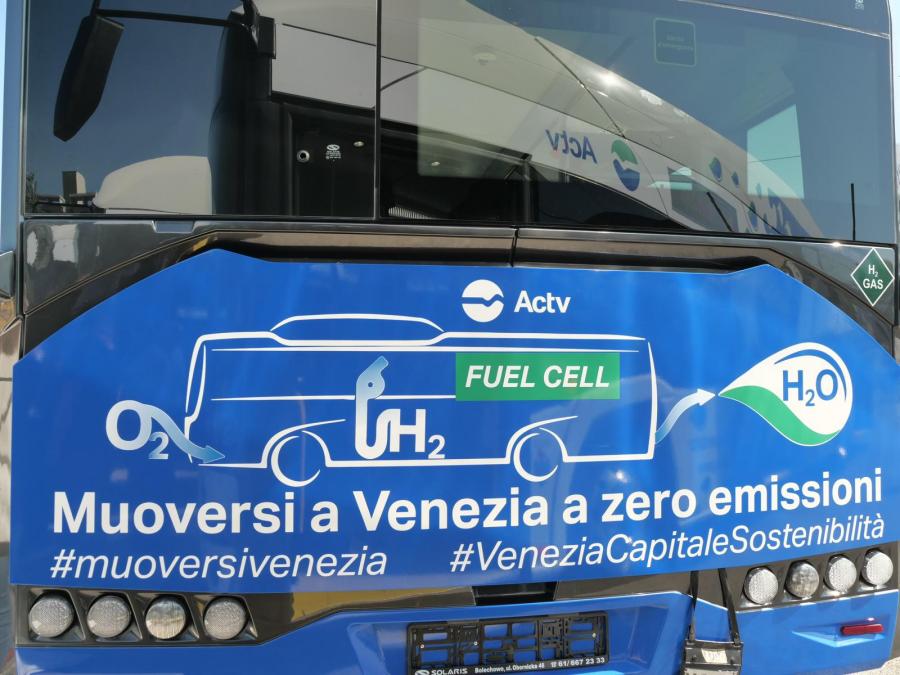
The Avm/Actv group has finalized the purchase of its new hydrogen bus fleet; these vehicles will be fully operational by the end of the year, marking a step toward quieter, more sustainable mobility.
Mauro Luigi Valenti, the company’s General Manager (officially designated as *Procuratore Generale*), explains the details.
Has the delivery been fully completed?
For the 90 PNRR-funded buses, yes—and within the deadline of June 30, 2026. However, we had previously purchased and deployed four other hydrogen buses, which entered service in 2023.
Are they all operational? On which routes?
Currently, a few buses are operating on a rotating basis across the urban network. The entire fleet will be operational by the end of the year once the Eni facility in Marghera is ready—Eni has informed us that the new plant will be delivered by late autumn—and they will generally be deployed on all urban lines in Mestre.
How are the bus tests going? Are they finished?
They are not finished yet. These months of pre-service testing are specifically designed to identify any anomalies or recurring faults in the buses currently in rotation—issues typical of any vehicle equipped with innovative technology. Specifically, for the hydrogen buses, we are monitoring fuel cell calibration, valve settings, the hydrogen distribution system, and control software modifications. All these activities are monitored and managed in coordination with the manufacturer, who implements necessary corrective actions or software updates as needed.
When the buses were announced, a range of 400 kilometers was mentioned; is that confirmed?
Generally, yes—though, naturally, it varies depending on driving style, the environment, and external temperatures (such as the use of heating and air conditioning systems). Furthermore, potential performance degradation of the fuel cells will also need to be assessed in the future.
How long does refueling take?
The current filling station on Via Orlanda, which lacks a gas “pre-cooling” system, requires about 40 to 45 minutes. For the new facility currently being built by ENI in Marghera, the estimated time is between 10 and 13 minutes for 12-meter and 18-meter buses.
What are the key strengths and weaknesses of hydrogen buses?
On one hand, a hydrogen bus is essentially an electric bus that replaces the battery pack with storage tanks and a fuel cell; consequently, it lacks various mechanical components typical of internal combustion powertrains—such as the engine, transmission, drivetrain components, and associated auxiliary systems—resulting in a significant reduction in wear-prone parts and lower overall mechanical complexity. On the other hand, the vehicle incorporates more advanced, newly developed technologies—such as the fuel cell system, power electronics, and hydrogen distribution system—that require new, highly specialized skills and dedicated training for maintenance staff; the nature of the equipment also necessitates facility upgrades, coordinated with the Fire Department, including within the workshops. In short, the hydrogen bus is mechanically simpler but technologically more complex.
How does it compare to electric and internal combustion engine buses?
Currently, hydrogen buses have higher operating costs than both internal combustion and electric buses, due to the current scarcity of the product, which has not yet achieved the level of industrial and commercial adoption seen with the other types. All market forecasts predict a sharp drop in the price of hydrogen as its use cases expand. In terms of environmental impact, both electric and hydrogen vehicles are zero-emission.
What investment did this entail, and how were the costs covered?
The total investment was approximately €60.3 million; the majority was funded by the PNRR (National Recovery and Resilience Plan) for the supply of the 90 buses, while a smaller portion—covering the 4 buses that entered service in 2023—was funded partly through European funds.
How do you respond to those raising safety concerns? Who is responsible for the safety of the fleet operating on the mainland?
Responsibility for the safety of the active fleet lies with Actv, as the operator. This also applies to maintenance, which will be carried out both at the Via Martiri della Libertà workshop and at the new facility located at the Eni distribution and depot site in Marghera. Precisely because hydrogen systems are “innovative,” we decided to handle only “traditional” vehicle maintenance in-house, while tasks related to storage tanks, high-voltage systems, hydrogen supply systems, and fuel cells will be outsourced to external companies. In any case, there has been constant dialogue over recent months with all the relevant safety authorities…
C.I.D. s.r.l. Società a Socio Unico – Casa editrice del settimanale Gente Veneta – CF e PI 02341300271 – REA: VE – 211669 – Capitale Sociale 31.000 euro i.v. – Dorsoduro,1 – 30123 Venezia
Iscriviti a GREEN&SALUS e non perderti nessun aggiornamento, ti invieremo 1 volta a settimana i nuovi articoli!