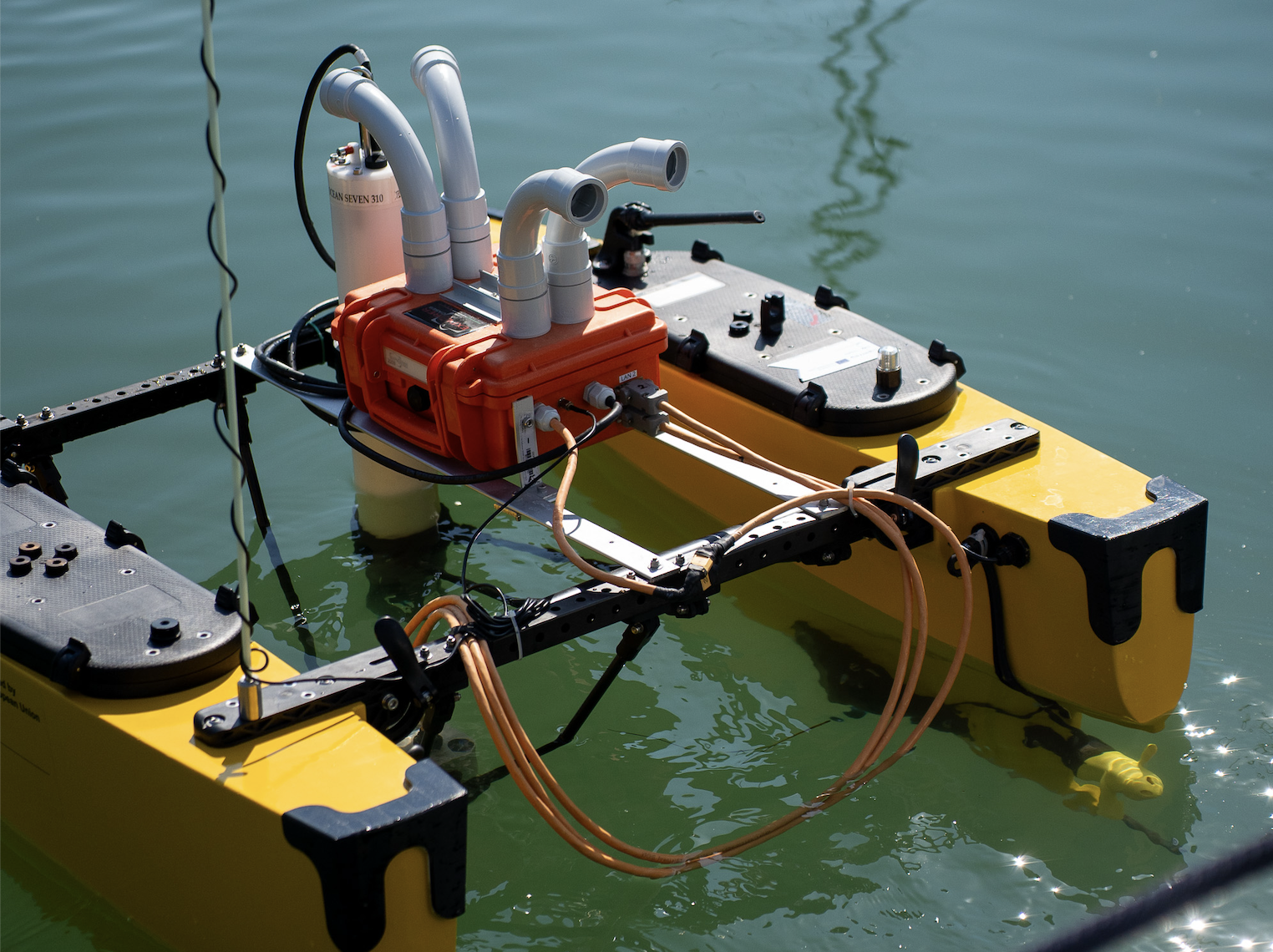
Autonomous marine drones to monitor water quality and promptly detect signs of environmental degradation. This is the result of the BRIGANTINE project , a two-and-a-half-year Interreg Italy-Croatia initiative that concluded on September 15 with an event on Certosa Island. The project developed a platform of autonomous surface vehicles (ASVs), created by the University of Udine—the lead partner—together with the Polytechnic University of the Marche, the University of Zagreb, the Ruđer Bošković Institute, and CORILA (Consortium for the Coordination of Research on the Venice Lagoon System).
These compact, modular drones measure temperature, salinity, dissolved oxygen, and other water quality parameters in real time and capture multispectral images of seagrass beds. The combination of sensors and imagery also makes it possible to detect early signs of degradation, such as the presence of potentially invasive alien species and the accumulation of plastic. The technology is now available to institutions interested in using it for their monitoring activities.
The experimental surveys covered three areas of the Northern Adriatic: the Conero Riviera, the Grado and Marano Lagoon, and the Šuča Lagoon in Croatia. Monitoring confirmed the good health of the Cymodocea nodosa seagrass beds and documented, at two sites on the Conero Riviera, the disappearance of the brown alga Gongolaria barbata. The data also revealed a correlation between chlorophyll content and the vegetation indices measured by multispectral cameras, opening up the possibility of non-destructive monitoring of seagrass beds.
One of the aspects addressed by the project concerns the speed with which data can be transformed into usable information. The surveys are processed and published on CORILA’s data infrastructure in near real time: a survey conducted in the morning can be viewed as a map as early as the afternoon. The data, published according to open standards, can also be integrated with marine habitat mapping derived from Sentinel-2 satellite imagery. The system can also automatically generate a compliance report with respect to the Maritime Spatial Management Plan.
The goal is to complement—not replace—existing monitoring systems, such as satellites and fixed stations, by helping to create an early-warning system capable of anticipating rapid phenomena, including anoxic events. “Our drones are sentinels of the lagoon: tools that continuously monitor what is happening beneath the surface,” explained Pierpaolo Campostrini, general manager of CORILA, emphasizing the importance of integrating different observation technologies.
Finally, BRIGANTINE provides a system designed to be expanded with new sensors, ranging from eDNA sampling to acoustic and contaminant detection instruments, and even sonar for seabed mapping. According to the project, the platform could also have economic benefits, ranging from reduced monitoring costs for ports, aquaculture, coastal structures, and dredging to the opportunity for small and medium-sized enterprises to develop their own services on a public data infrastructure.C.I.D. s.r.l. Società a Socio Unico – Casa editrice del settimanale Gente Veneta – CF e PI 02341300271 – REA: VE – 211669 – Capitale Sociale 31.000 euro i.v. – Dorsoduro,1 – 30123 Venezia
Iscriviti a GREEN&SALUS e non perderti nessun aggiornamento, ti invieremo 1 volta a settimana i nuovi articoli!