
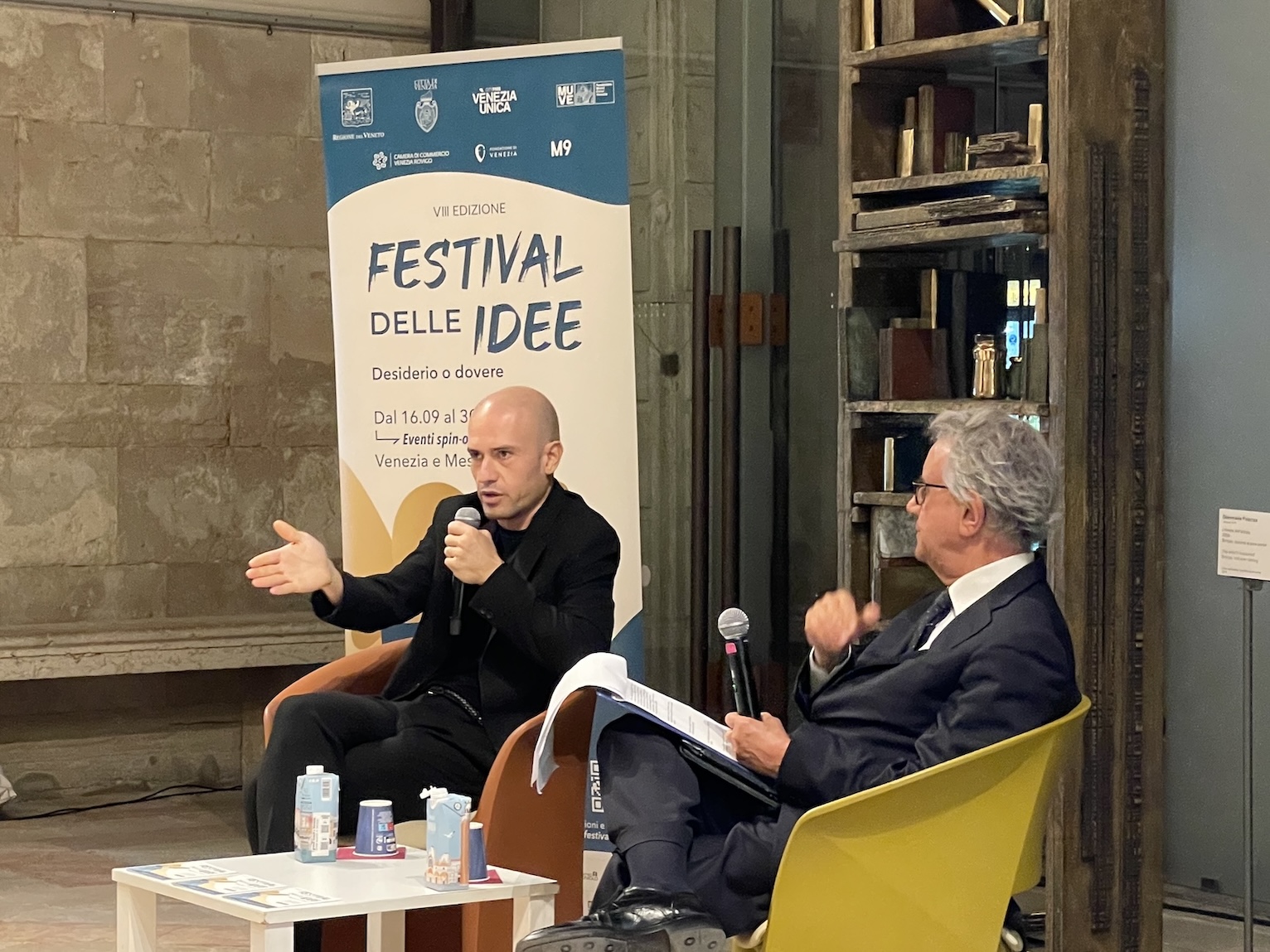
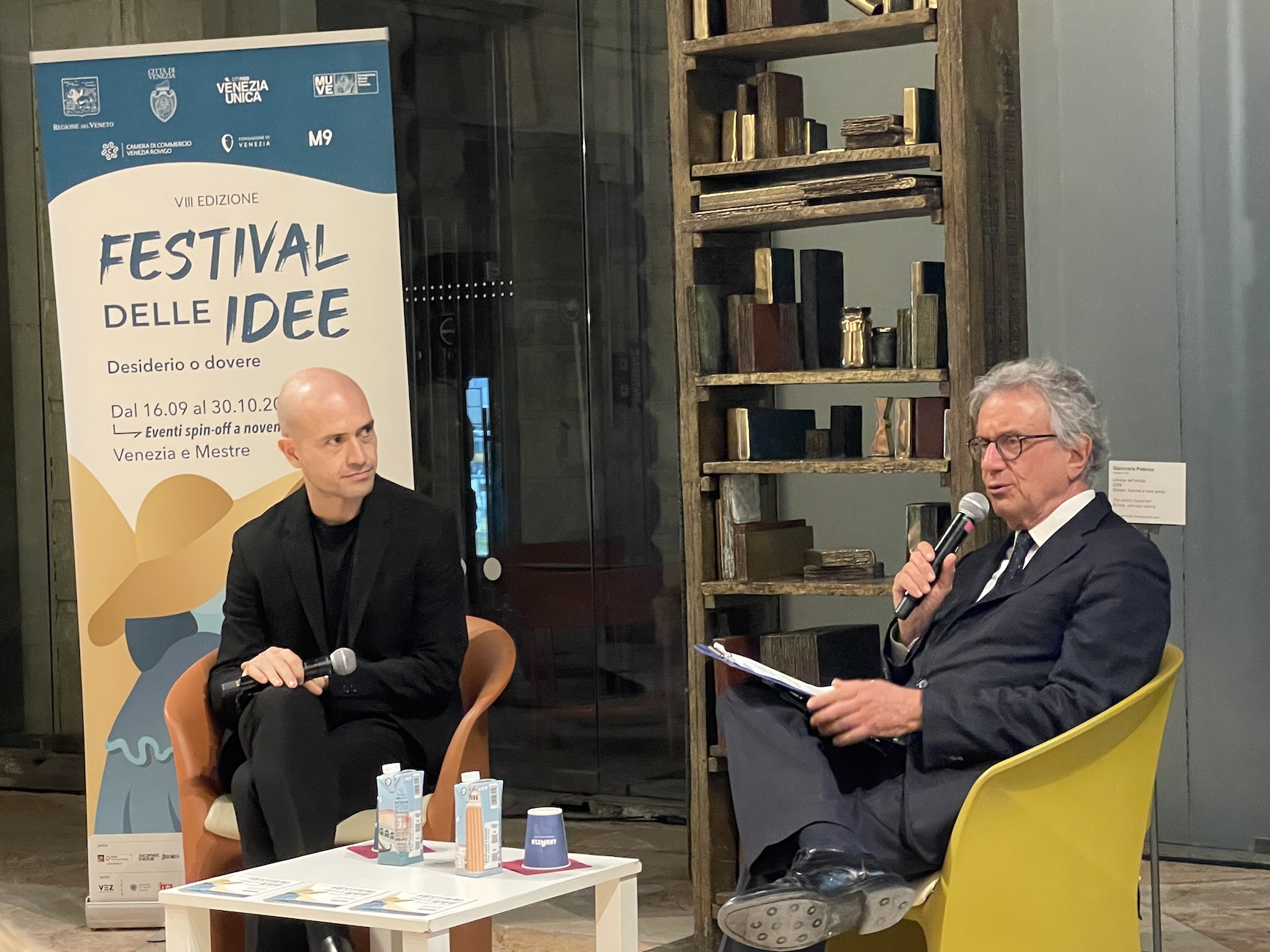
Getting to where he is now hasn’t been easy; at first, he couldn’t find any galleries willing to represent him, and it was thanks to the virtual world that he gained visibility. He was just a young lad when, in 2007, he travelled to Greece to work for a sculptor who didn’t pay him; to make ends meet, he cleaned the toilets in a restaurant: ‘One day I saw the restaurant owner using Facebook; I realised the potential of social media and started using the photo gallery as a showcase for my work. With technology, my creative process becomes a catalyst for opportunities,’ he says. He then also began using videos to showcase his creative process, primarily to satisfy his own curiosity about witnessing the creation of things.
“Social media, however, has changed today; it’s just self-congratulatory TV. Anyone starting out now should think about what the next step is, rather than trying to fit into a system that’s already set in stone. – he warns, explaining how he makes personal and judicious use of social media – ‘My home page only shows me what interests me because I don’t want to be distracted or influenced; the risk is getting caught in an endless loop and forgetting to live.’
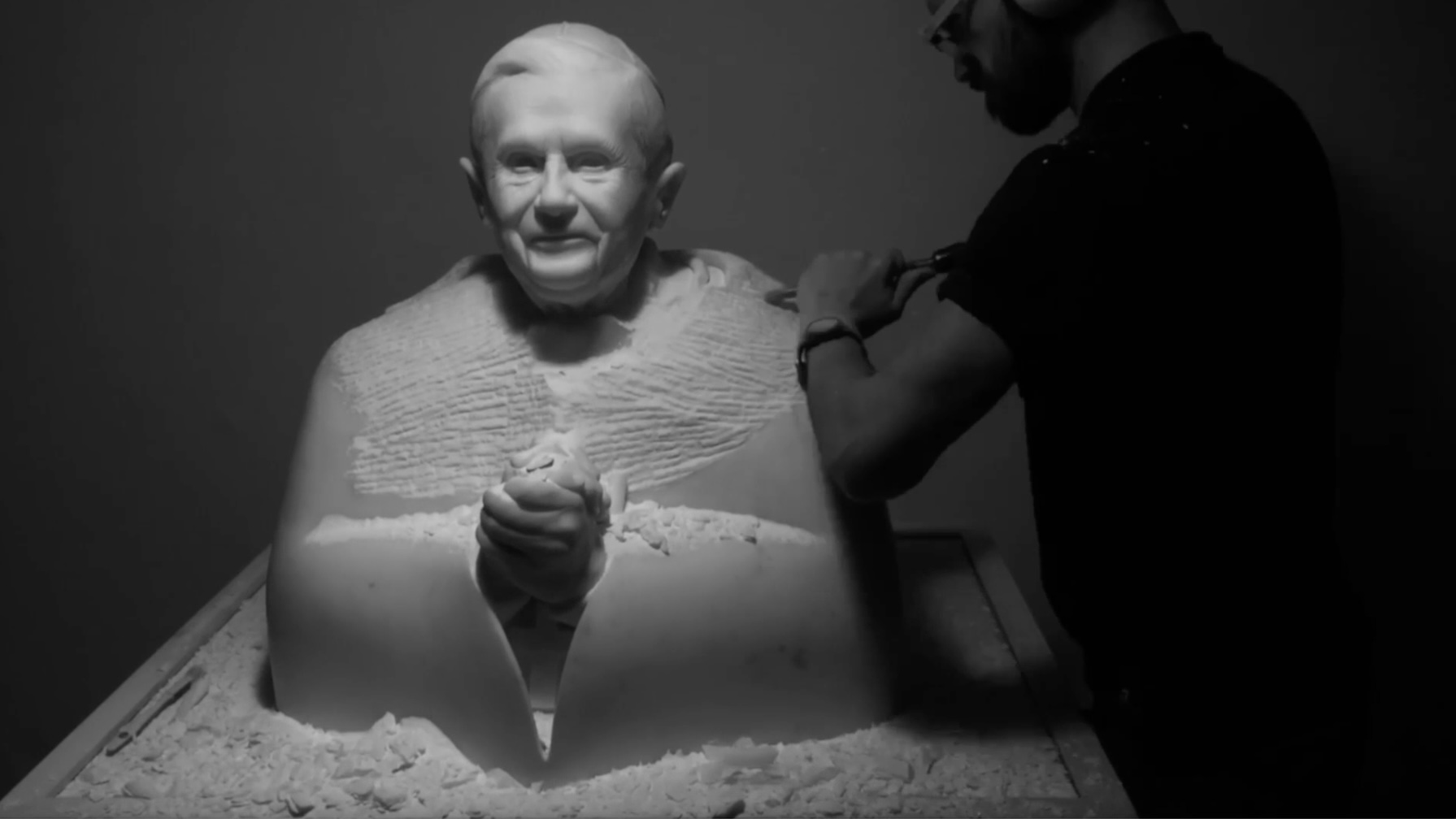
Having begun to make a name for himself at the age of just 24, Jago was selected by Vittorio Sgarbi in 2011 for the 54th Venice Art Biennale, where he exhibited ‘Habemus Papam’, the marble bust of Pope Benedict XVI created in 2009. This early work was subsequently reworked by the artist between 2013 and 2016, after the Pope had abdicated the papacy. Jago intervened on the work by literally stripping the Holy Father of his papal robes with a chisel and renaming it “Habemus Hominem”: “Whilst the sculpture was on display at an exhibition, I received a message from my father in which he told me: ‘The Pope has undressed’. I sensed that in that work there was an opportunity to say something better than the stereotypical portrait I’d been commissioned to create. I could intervene again, and perhaps the most interesting insight was to leave a trace of the process of stripping away the clothing,” says the sculptor, who, by reworking the material, anticipated the signs of the Pontiff’s ageing with such precision in rendering the texture of the skin that it sends shivers down your spine.
A level of perfection for which he has repeatedly been dubbed the new Michelangelo: ‘A ridiculous comparison. Even when Tokio Hotel first came onto the scene, people said they were the new Beatles, but the only thing they had in common was that they played music and used the same instruments. – he continues – ‘Being called Michelangelo is no source of pride for me; I want to be the next version of myself,’ he says, referring to the fact that marble is the only thing he has in common with the Renaissance master, given that the techniques and the rendering of the material are clearly different. However, he does not condemn those who compare him to the genius of the past: ‘Today we have the great opportunity to build on someone else’s footsteps in order to find our own; there is nothing wrong with being inspired by the greatness of others – the only risk is finding oneself.’
Marble is a material that requires time and great physical effort: ‘It’s an act of translation which, in my case, creates dust and noise. I have an image in my head and I satisfy my desire to see it realised by working on the material for up to three years.” – he emphasises – “This is what makes me feel good and gives me a sense of fulfilment.”
Sculpture works by subtraction; indeed, it is only by removing the superfluous that one arrives at an image: ‘Within that physical space there exists an infinite number of possible images, and from among them I take on the responsibility of choosing one and devoting myself to it for years’.
Every creation he works on triggers a process of reflection: “Every work is both a destination and a turning point, because it suggests to me what will come next.
I can’t describe the creative process, but I put myself at the mercy of a mechanism of sensitivity. – and he jokes – ‘My wife puts up with my absences and my staring into space,’ he says, explaining that he continues to nurture the child within him because it allows him to see the multiplicity of things.
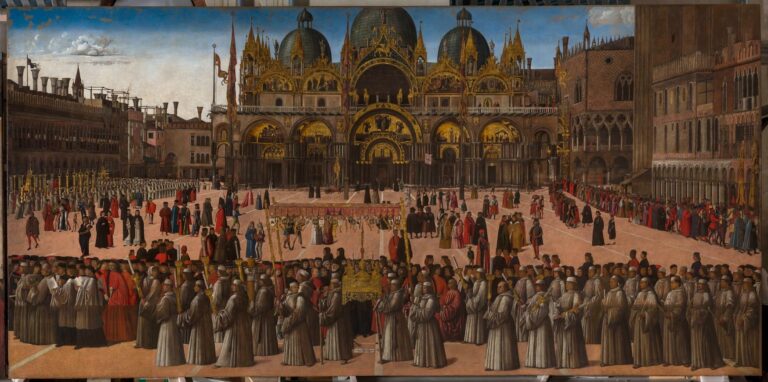
For Jago, Venice is a city of great inspiration: “I enter a realm where it seems astonishing to me that so much beauty could exist, pouring down upon you,” he says. “I could spend a whole day sitting in front of a façade, observing a glimpse or a passing ray of light.”
Every time he leaves the city of water, various impressions settle within him. “One work in particular, ‘Still Life’, made up of weapons, was conceived in Venice after I saw Canova’s ‘Fruit Baskets’.”
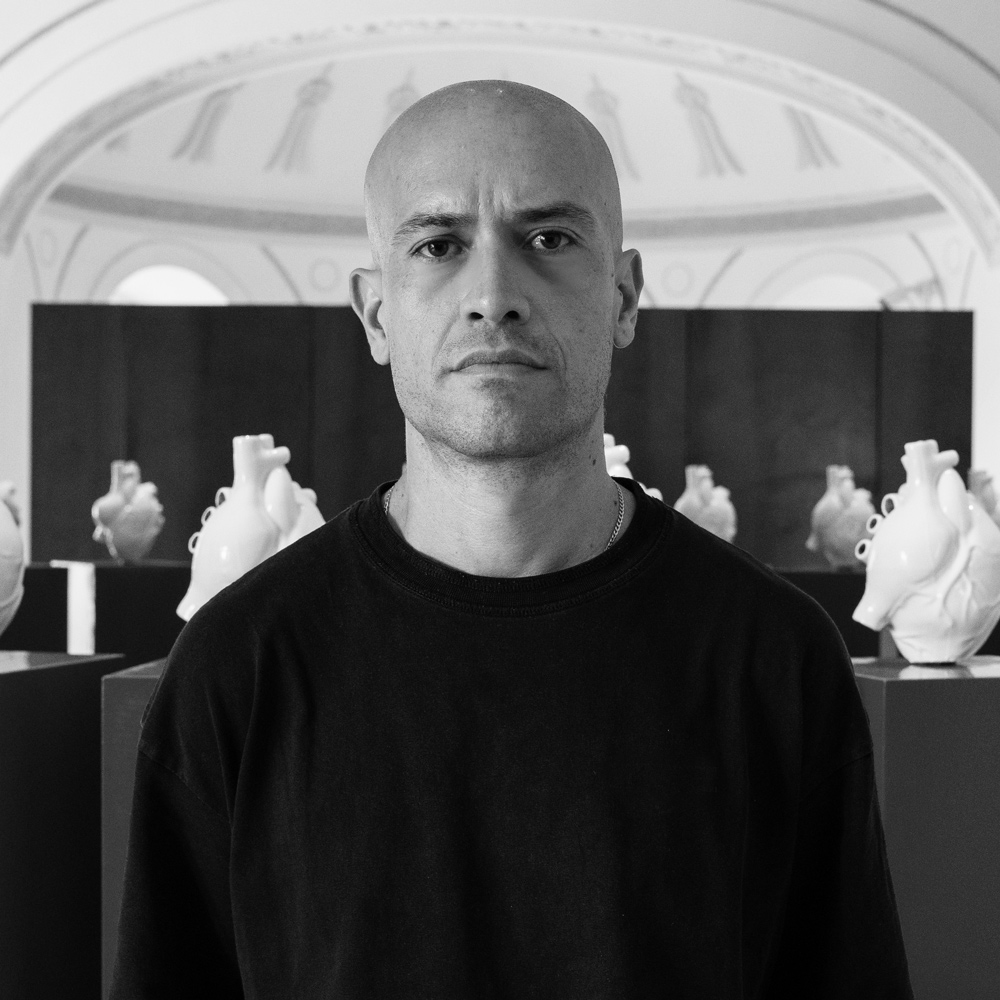
The only artist in the world to have sent a sculpture into space (his small work ‘The First Baby’, weighing 200 grams, which depicts a foetus, which arrived at the International Space Station in 2019 thanks to the mission’s lead astronaut, Luca Parmitano), what emerged about Jago during the conference is that he is also a great entrepreneur who has managed to turn what he does best into a brand. In 2023, the Jago Museum will open in the church of Sant’Aspreno ai Crociferi, in the Rione Sanità district of Naples – formerly his workshop – where he employs many people: “The Jago Museum is an attempt to safeguard an idea of beauty. ’ he explains. ‘It is an exhibition format that, if desired, can be realised anywhere. There is no single art system, but rather multiple art systems, and this opens up the possibility of new scenarios and major collaborations.’ Indeed, this year he has also brought the format to the historic spaces of Villa Lysis on Capri.
The idea of co-ownership of the works is his: “Each of my works is a 50-50 partnership. I have investors from all over the world who are co-owners of certain works, which are then displayed in my museum,” he clarifies, adding that this allows him to be his own boss and remain sustainable, because everything he earns from the million-euro valuations of his works is reinvested in his company. ‘The young people who have been working for me in the museum’s communications team have grown from 13 to almost 60 today.’
The Jago Museum has welcomed 150,000 visitors this year, including many school groups, and everyone has the opportunity to take a guided tour of his works.
Although his works convey important meanings, Jago, as an artist, does not feel a responsibility to convey certain messages to the contemporary world; his art, in fact, responds to an imperative of absolute freedom. Nor does he feel the need to explain his works: “If I were to impose my meanings and my inner world through words, it would be a complete betrayal. This does not mean there is no concept, but I keep it to myself.”
On several occasions, the sculptor has seen his public works vandalised; most recently, in 2022, ‘Flagella Paratus Sum’, on display in the centre of Rome, was destroyed. Similarly, the sculpture ‘Look Down’, now in Rome in the courtyard of the Chamber of Deputies at Montecitorio, has been the target of various acts of vandalism. ‘In 2020, when we installed it in Naples’ Piazza del Plebiscito, a poodle immediately urinated on it,’ recalls the sculptor. ‘That was a great lesson for me. If you put a work of art in a square, you have to expect that sort of thing; I don’t take it personally’. So, when some young people vandalised it a few days later, his reaction was to invite them to his studio to get to know them: “They’d made a gesture in a video without even realising it, and they were exploited on TV. I recognised a lot of myself in them. As a lad, I did far worse – I set fire to a palm tree in Anagni the day before my First Communion.” – he recounts – “When they came to the studio, it was a wonderful moment. I gave them a hammer and chisel and let them experience what it means to sculpt. They realised just how difficult and complicated it is to kneel all day long for years on end, and they understood how easy it is, by contrast, to destroy. They thus grasped the difference between a creative act that involves breaking things and the act of destruction for its own sake.”