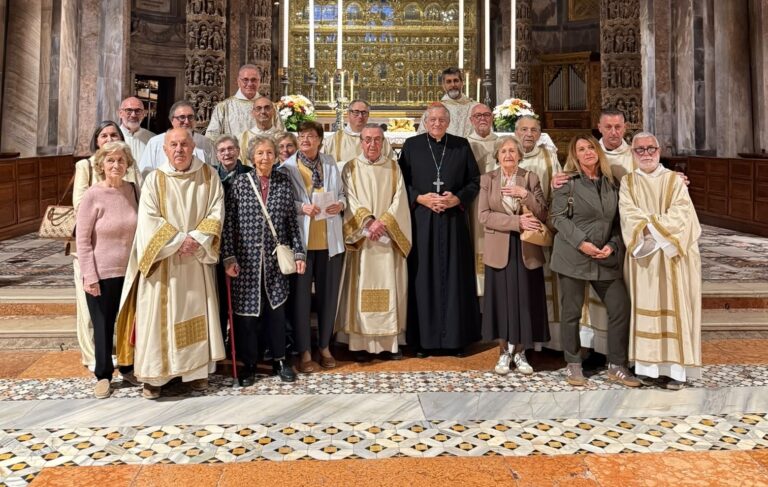
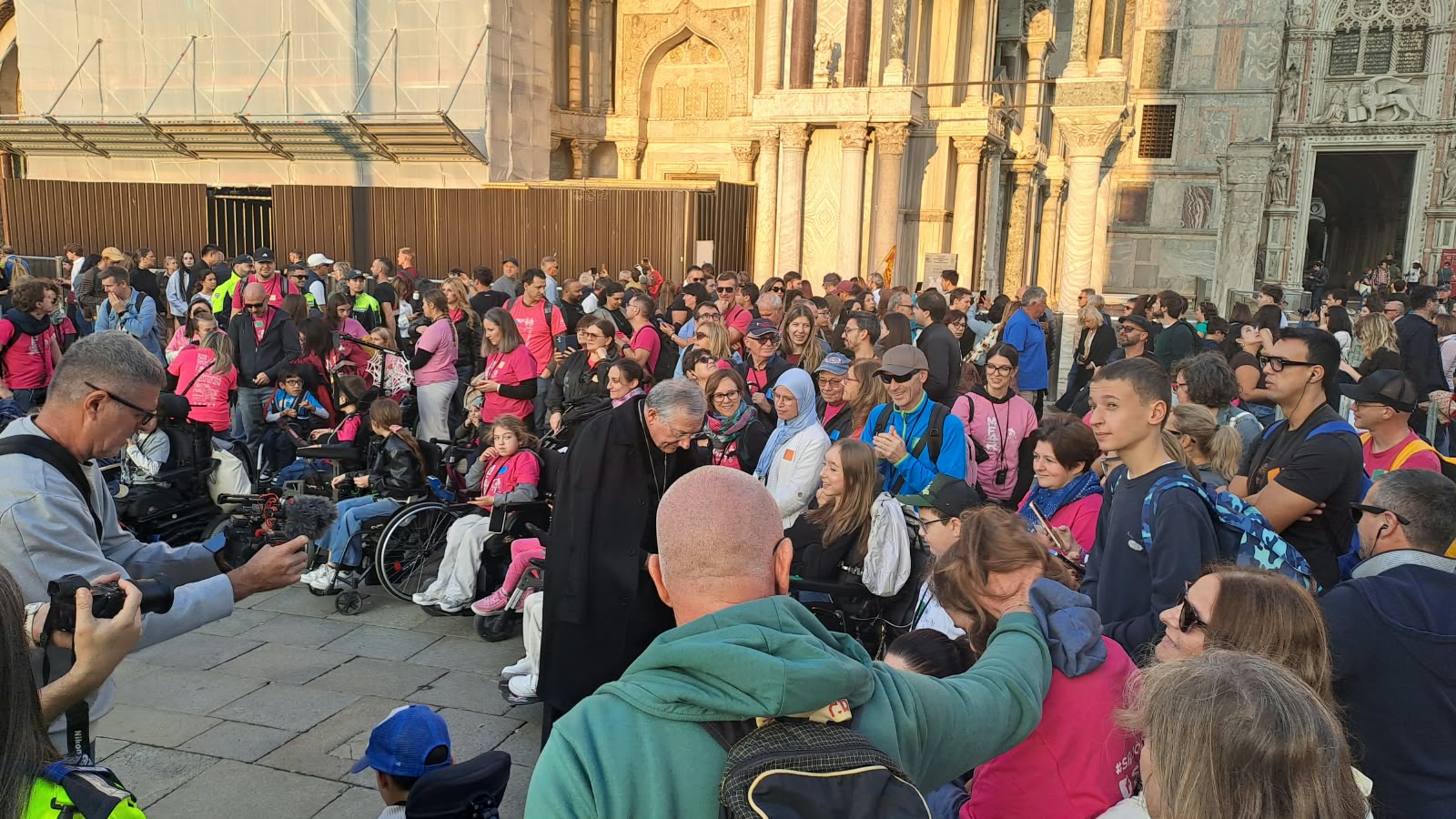
On Saturday 17 October, in St Mark’s Square, Patriarch Francesco Moraglia, Mayor Simone Venturini and Chief Procurator Bruno Barel welcomed the children and young people with spinal muscular atrophy taking part in ‘Venezia a 4 Ruote by night’. This event highlights the importance of accessibility and forms part of the “Venezia accogliente” project, through which the Procuratoria is working to remove architectural and sensory barriers at the Basilica and the Campanile. This same focus on people also inspired the acquisition of the property belonging to the Franciscan Sisters of Christ the King in Castello, which is intended to house a nursery school and provide affordable accommodation for those working in the city. The visit to the Bell Tower took place at a particularly significant time for the Procuratoria, which is currently engaged in the two-year ‘Venezia accogliente’ project, dedicated to overcoming the architectural and sensory barriers that can hinder access to the Basilica and the Bell Tower. From 10 to 18 October, in fact, the ‘The Top for All’ initiative enables people with reduced mobility, including those using manual or electric wheelchairs, to reach the lift access level of the Bell Tower independently via a special mobile ramp. This is a temporary ramp, but one of practical significance, made possible thanks to a contribution from the company EPS and the collaboration of the Patriarchate of Venice. Entry to the Bell Tower is free for people with disabilities and one accompanying person, with no booking required. It is in this context that Bruno Barel, First Procurator of St Mark’s, comments on the Procuratoria’s wider efforts in support of the city.
What message does this day leave us with?
St Mark’s Basilica is a part of our shared world heritage, and we feel a responsibility to ensure that as many people as possible can discover and experience it. The preservation of a monument is not merely a matter of conserving its structures and works of art: it also means considering how to make it accessible, whilst respecting its historical and architectural characteristics.
The Patriarch of Venice, Monsignor Francesco Moraglia, was also present at the event, where he welcomed the children and young people alongside their families. In his address, he emphasised the importance of taking on a challenge that enables us to stand by those who risk facing obstacles in exercising a right or fulfilling a wish.
The Basilica is a place that belongs to everyone and must be accessible to those with mobility difficulties, the Patriarch emphasised, expressing his satisfaction at having been able to accompany and greet the young people, the children and their parents. Initiatives such as this enable us to offer something tangible to the city and ensure that these young people, too, can engage with the Basilica and feel that it is part of their own experience.
The ‘Welcoming Venice’ project is being implemented through a range of initiatives, from the Bell Tower to the Basilica Museum. What are the next objectives?
Work is currently underway and requires a range of skills. In 2025, we created a tactile three-dimensional model of the Basilica, thanks to the collaboration of the Rotary Club of Venice and the support of foundations, institutions and private organisations. It is a tool that enables blind people to explore the monument’s architecture through touch and to gain an understanding of it in a different way.
From the accessibility of cultural venues to the possibility of living in Venice, the theme of inclusion also highlights the social dimension of the Procuratoria’s work. This perspective is reflected in the acquisition of the property belonging to the Franciscan Sisters of Christ the King, in the Castello district. Why did you decide to get involved in this property deal?
We have sought to reconcile two fundamental requirements. The first is to safeguard the assets of St Mark’s Basilica, as they represent a guarantee for the future. During the Covid year, income came to a standstill, whilst the Basilica requires considerable investment: we currently have nineteen construction sites. It is therefore essential to have a financial safety net that enables us to protect the monument, ensure the continuity of the work and deal with any difficult situations that may arise. The second requirement is that every initiative we undertake should also serve a social purpose. We are not a speculative property development company, but a not-for-profit organisation. We want every project to generate added value – not only in economic and heritage terms, but also in social terms. Preserving our heritage and caring for the community are not competing objectives: they can reinforce one another. Making a monument accessible and helping to keep the city alive are different ways of fulfilling our responsibility towards people.
How did the opportunity to acquire the property in Castello come about?
The nuns, now numbering just four, were considering selling off a significant property portfolio situated about twelve minutes’ walk from St Mark’s Square. They were particularly concerned about the future of the nursery school housed within the premises, an institution with a long history that cares for thirty-two children. We carried out a thorough assessment, albeit within a short timeframe, as other private-sector parties were also involved in the negotiations. We felt it was important to ensure this opportunity was not lost, not only for the Procuratoria, but above all for the city. The negotiations were swift, straightforward and transparent, with no intermediaries. Following the necessary assessments, we concluded that the transaction was of great interest to the Procuratoria and approved it unanimously. We referred to a valuation report drawn up by an independent expert, a professor at the University of Padua, and concluded the purchase at a price lower than the value indicated in the report. A technical report also highlighted that the property is in good condition and can be reused with relatively limited extraordinary maintenance work. The complex covers approximately 4,100 square metres and comprises fifty-six en-suite rooms, two gardens, spaces designated for a nursery school and a church. We saw an opportunity to enhance this property whilst preserving its heritage and restoring it to a use consistent with the city’s needs.
What will the complex be used for, and how will the continuity of existing activities be ensured?Quali saranno le destinazioni del complesso e come verrà garantita la continuità delle attività già presenti?
The nuns had set two conditions for the transfer: to ensure the continuity of the nursery school and to retain, on the ground floor, a small space to serve as a chapel, dedicated to the memory of a fellow nun who had been a valuable spiritual guide. We have agreed to both requests. As regards the school, the Procuratoria is not permitted under its statutes to manage educational activities directly. We therefore explored the possibility of involving the Diocese, which responded positively through the body designated to manage the school. The collaboration between the Patriarchate and the Procuratoria has thus made it possible to find a practical solution. The school will be able to continue its activities, providing peace of mind to the families of the thirty-two children who attend it. The residential part will be used as guest accommodation for the Procuratoria’s staff and as accommodation for other people working in Venice. The idea is to refurbish the existing rooms and, where possible, combine them to create small flats, suitable for couples and families alike. We wish to offer sustainable financial terms that ensure a balanced return on investment without placing an excessive burden on the incomes of those working in the historic city. Venice needs people who can live there permanently, as well as those who work there. The difficulty of finding accommodation at a cost compatible with local salaries affects the very possibility of keeping services and activities running.
To what extent did the possibility that the property might end up in the hands of investors interested solely in commercial development play a part?
It was an important element, but the key point is to have identified a destination consistent with the nature of the asset and Venice’s needs. A property of this size, in such a significant location, represents an asset for the city. If it had been intended solely for a market logic, an opportunity could have been missed to maintain an educational service and offer housing to workers. We have followed the procedures provided for, including those relating to the possible exercise of the right of first refusal by public bodies, with the will to act correctly and with full transparency. Our responsibility is to ensure that the assets continue to be useful. This requires attention to accounts, but also the ability to look beyond the immediate value of an asset and question the function it can perform over time.
What is the planned timeframe for the property’s redevelopment, and what future do you envision for the complex’s historic spaces?
Initial forecasts indicate that work will not be able to begin before the end of 2027, a timeline that will need to be confirmed in light of the design and authorization process. The technical evaluation gave us confidence, because the property does not seem to require a particularly long or invasive restoration, but safety, the functionality of the spaces and compliance with the agreed destinations come first.
We would also like the church in the complex to be accessible to the public again. It is a space that deserves to be known and valued, respecting its identity and history. We will be able to evaluate, at a later stage, any cultural initiatives or other forms of use compatible with the location and economic sustainability of the intervention. A building isn’t just made up of square meters, rooms, and possibilities: it’s also a repository of relationships, experiences, and stories that have helped build a community. When dealing with heritage of this kind, one must be able to distinguish what can be rethought from what deserves to be kept.
Do Castello’s accessibility initiatives and housing project reflect a broader vision of the Prosecutor’s Office’s role in Venetian life?
Our primary mission remains the protection of St. Mark’s Basilica and its preservation for future generations. But being present in Venice also means recognizing the context in which the Basilica lives. The city is not just an artistic heritage to visit: it is a community, with housing needs, services, jobs and relationships to preserve.
Iscriviti a CRUX e non perderti nessun aggiornamento, ti invieremo 1 volta a settimana i nuovi articoli!